


What Is a SOC Report? Types and How to Get One
Receiving a procurement email requesting your company’s latest SOC 2 report can feel daunting, especially if you’re not yet familiar with SOC reports.
If your business stores data in the cloud or handles sensitive information,it needs independent evidence that its systems and processes are reliable. In this post, we will explain what a SOC report is, which type of report you are likely to need, how to obtain one, and what to consider when selecting an independent examiner.
What is a SOC Report?
A SOC report is an independent examiner’s opinion on the controls in a service organization. Prospective clients commonly do not rely solely on a company’s assurances of its trustworthiness. Rather than asking customers to rely on assurances alone, a company can provide them with a report prepared by a licensed CPA firm.
The SOC framework is developed by the AICPA, which is a U.S. accounting body, whereas the reports are issued by licensed CPA firms. There are four sections for a SOC report.
- The first section is a description of the system or service provided by management.
- The second section is management’s assertion about the system or service.
- The third section is the independent examiner’s opinion.
- The fourth section is a description of the examiner’s tests and the results of the tests.
A SOC report is the result of an attestation examination of a service organization's controls. The independent service auditor evaluates the controls and expresses an opinion, including any exceptions identified during control testing.
Outside the United States, you will encounter the same fundamental concepts, although different terminology may be used. ISAE 3402 is the international equivalent of SSAE 18 (SOC 1). Auditors in the Gulf region and Europe frequently issue SOC 2-type reports based on ISAE 3000.
Why Do SOC Reports Matter for Your Business?
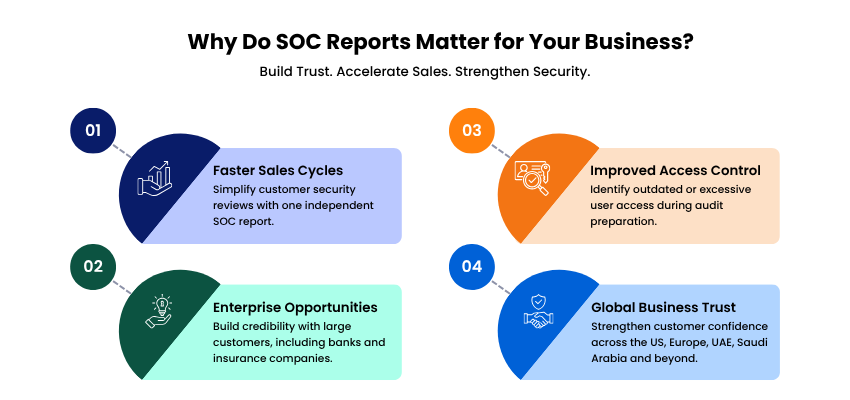
Potential customers won’t be convinced by “we take security seriously” anymore. A SOC report gives them evidence and provides you with several benefits, including:
Faster sales cycles- one report can answer many security questionnaires.
Enterprise Access: The ability to serve larger customers, such as banks and insurance companies.
Better access control: As you prepare for the examination, you may identify outdated or excessive access rights.
Global recognition and trust- Clients in the US, Europe, the UAE, Saudi Arabia, South Africa, and beyond appreciate seeing SOC reports.
To be clear, clients who expect and require SOC reports aren’t looking to replace other certifications and attestations, such as ISO 27001. Instead, they request a SOC report for additional assurance.
Types of SOC Examinations: Which One Fits Your Organization?
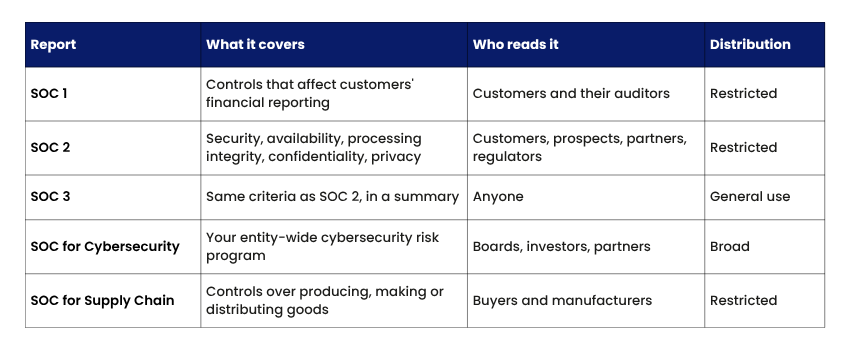
There are five types, and you should focus on the one that best addresses your customers’ concerns. For more information, see our article on SOC 1 and SOC 2.
SOC 1 Examination: Controls Supporting Financial Reports
Choose SOC 1 if your services affect your customers' internal control over financial reporting (ICFR) and their financial information, such as loan-based services, payments, payroll or claims. Your customers' auditors rely on the report for their financial statement audits.
It is conducted in accordance with SSAE 18 in the United States and ISAE 3402 in other countries.
SOC 2 Examination: Controls Behind Data Security and Trust
SOC 2 is the assessment vendors ask about most often. It evaluates your controls against the AICPA's Trust Services Criteria: security (which is always required), and, as applicable to your service, availability, processing integrity, confidentiality, and privacy. For example, a web hosting company may include availability, while a health and wellness application may include confidentiality and privacy. Our SOC 2 explainer provides an overview of each criterion. The assessment is conducted under SSAE 18 or ISAE 3000"; ISAE 3402 applies to SOC 1.
SOC 3 Examination: The Public-Facing Version
SOC 3 reports use the same framework as SOC 2 reports but provide less detail. As a result, they can be shared more broadly, including on a company’s website. SOC 3 reports are often included alongside SOC 2 reports as additional marketing collateral. However, potential clients conducting due diligence will still request the full SOC 2 report.
SOC for Cybersecurity: Proof of Your Risk Management Program
Unlike SOC 2 reports, which address specific services, SOC for Cybersecurity reports assess how an organization manages cyber risk across the organization as a whole. Accordingly, they are more suitable for boards and executive management, investors, and cyber liability insurance companies.
SOC for Supply Chain: Assurance Across Your Vendor Network
The AICPA introduced this service report in 2020 for organizations and entities that produce, manufacture or distribute goods. It assesses their systems and processes against the rust Services Criteria and the 2020 Description Criteria (DC 300).
SOC Type 1 vs. Type 2: What's the Difference?
The Type 1 and Type 2 classifications apply to SOC 1 and SOC 2 reports, not SOC 3. They describe the scope of the examination and the level of assurance provided. For more details, see our post on SOC 2 Type 1 and Type 2.
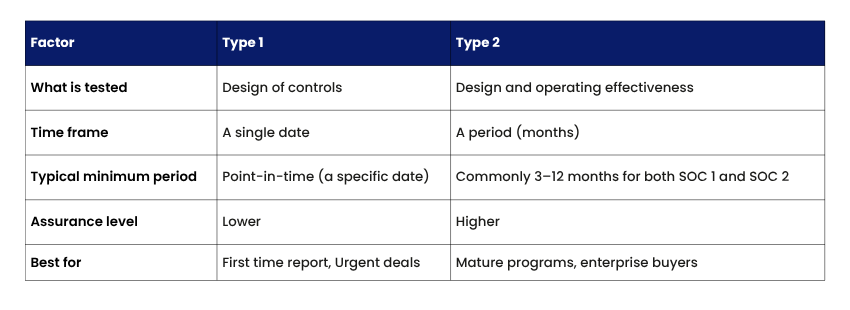
Many organizations start with a Type 1 report to help close a deal, then transition to annual Type 2 reports. Over time, larger customers often request Type 2 reports because they provide assurance that the controls operated effectively throughout the period.
What Does the SOC Reporting Process Look Like?
The complete process takes several months. Steps 1-4 cover most of the preparatory work. The longest and most demanding phase begins with step 5 (Note that step 5 applies to Type 2 only), the observation period. Details for each step are below.
The general overview of the process is:
- Choose the report and scope - Match the report to your customer's request and define the systems and criteria in scope.
- Run a readiness gap analysis - Identify gaps in policies, controls and evidence
- Close the gaps - Add better procedures, tighten your access, set up logging and train your team.
- Look for an independent examiner- Check the firm's licensed CPA firm, experience in your industry, and independence from whoever built your controls.
- Operate through the observation period- For Type 2, keep collecting evidence while controls run.
- Fieldwork and testing- The examiner interviews staff, samples evidence and reports any exceptions.
- Draft, review, final report- You review the draft, sign management's assertion and receive the report.
- Renew annually- Customers expect continuous coverage, so most companies repeat the cycle every year.
Collect evidence from day one of the observation period. Audits often run long because teams must reconstruct evidence for access reviews completed months earlier.
Conclusion: Get Your SOC Report from an Independent Assurance Partner
Misconceptions about SOC reports often arise from a misunderstanding of what they evaluate. SOC reports provide customers with independent assurance about how a service organisation designs and operates its controls to protect customer information. They address the customer's question: "How do they protect my information?" Organisations seeking to demonstrate the operating effectiveness of their controls over a period of time should consider a Type 2 report. However, obtaining a SOC report requires considerable time, effort and coordination.
The examiner must remain independent and must not have designed or implemented the controls being examined. SOC 1 and SOC 2 reports are issued by a licensed CPA firm in accordance with applicable AICPA requirements. INTERCERT, through INTERCERT CPA LLC, provides independent SOC examinations, evaluating the design and operating effectiveness of an organisation's controls to provide assurance to customers and business partners.
Want help choosing the right report? Talk to our team or explore our SOC services.


 +1 (281) 720-3261
 info@intercert.com
 2001 Timberloch Place - Suite 500, The Woodlands, Texas 77380, United States