


PCI DSS Non-Compliance: Penalties, Breach Costs and Business Risks
Most businesses become aware of PCI DSS when they encounter requirements in their merchant agreement, receive a questionnaire from their acquirer, or get a friendly reminder to complete one. While dealing with merchant-payment-related matters, someone on the finance team may ask, “What happens if we don't comply?” In the short term, there may be few visible consequences.
This guide explores the consequences of PCI DSS non-compliance, sharing actual figures where available and clearly noting when they aren’t. The goal isn’t to cause alarm, but to help you weigh the cost of fixing gaps now against the cost of explaining them later.
When the security of a payment transaction is compromised, businesses can face serious consequences, including forensic investigation costs, higher payment acceptance costs and loss of customer confidence. This guide explores the consequences of PCI DSS non-compliance and explains why addressing compliance gaps proactively can be less costly than dealing with their consequences with customers and regulators.
Who Needs to Be PCI Compliant?s
Any entity that stores, processes or transmits cardholder data or can affect the security of the cardholder data environment (CDE) must comply. Some examples of these businesses include:
- Retail and service merchants
- Processors and gateway providers
- Some software-as-a-service (SaaS) providers
- Data center and cloud providers
- Call center providers that handle cardholder data
The growth or size of business does not affect PCI DSS applies regardless of size: if you are in the process of working with card payments, you must comply with PCI DSS. The validation process may vary depending on your transaction volume and PCI DSS level. For example, Visa considers merchants that process over 6 million Visa transactions annually. Add validation: annual ROC by a QSA (or ISA, signed by an officer) and quarterly ASV scans. Level 1 merchants require external validation of their compliance. Level 2 merchants, which process between 1 and 6 million transactions, must complete an annual SAQ and quarterly ASV scans. Add "Visa" before "transactions.

PCI DSS applies globally through card brand rules and merchant agreements. Also, the PCI Security Standards Council acts as the body responsible for maintaining the standards, but it does not enforce them. Sanctions for non-compliance are imposed by the card brands or merchant banks. Accordingly, merchants worldwide that accept Visa or other card brands’ cards are subject to the same PCI DSS compliance requirements. PCI DSS v4.0.1 (published June 2024) is the only active version; v4.0 was retired on 31 Dec 2024. Use "v4.0.1" consistently. The effects of these changes on compliance: however, some of the requirements will take effect on March 31, 2025. Our PCI DSS Compliance Guide covers what changed.
What Does PCI Non-Compliance Look Like?
Ignoring or avoiding PCI DSS requirements may seem to have no immediate consequences. However, it can cause inconveniences and put card data security at risk, including:
- Report on Compliance (ROC) for your SAQ or report.
- Failing to run quarterly external vulnerability scans by an Approved Scanning Vendor (ASV) (Req. 11.3.2).
- Failure to implement measures to secure card data. See PCI DSS Encryption Requirements for more information.
- Cardholder data environment (CDE). MFA is required for all access into the CDE (Req. 8.4.2) accessing the card data environment.
- Using a flat, unsegmented network where card data shares the network with all other systems to transmit and transport all other data of the merchant service along with card data.
- Insufficient logging and monitoring" (Req. 10) and "No oversight of third-party service providers" (Req. 12.8)
A common example is paper compliance, where controls that enabled compliance last year have since been removed or changed. Investigators and auditors focus on the environment’s current state to determine what is actually happening.
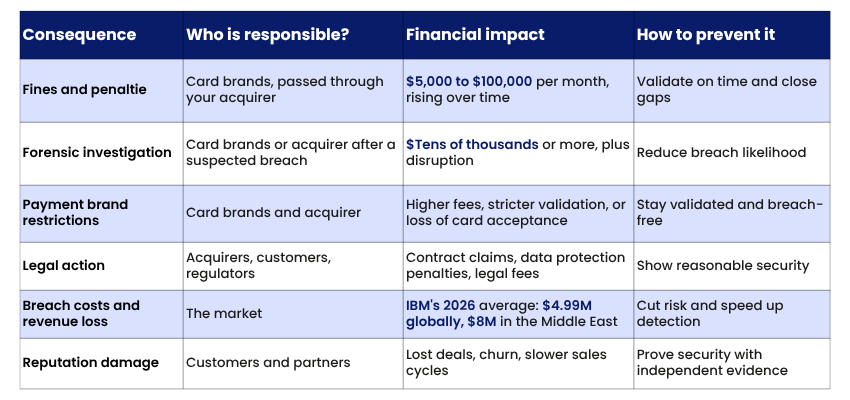
Consequences of PCI DSS Non-Compliance at a GlancePCI penalty ranges are based on industry sources; card brands publish no official schedule, and amounts vary by brand, acquirer, merchant level, and duration.
Monetary Fines and Penalties
The card brands charge these penalties to the acquirer, who then passes them on to the merchant through the merchant services agreement.Card brands do not publish fine schedules; however, commonly reported monthly fines appear to be as follows:
- First three months (per month): $5k - $10k
- Fourth through sixth months (per month): $25k - $50k
- From the seventh month on (per month): $50k - $100k
The exact figures depend on the factors that determine the price, including the volume you process, your assigned merchant level, the number of requirements not met, and whether you have previously violated any rules. Many processors charge monthly PCI non-compliance fees until validation is submitted, with ‘non-compliance’ fees to warn that larger fees may follow, putting smaller merchants most at risk.
Forensic Audits
Forensic audits are conducted by PCI Forensic Investigators (PFIs) to investigate breaches at the card brands' or acquirer's request; the merchant usually pays. The cost of such audits can range from $20,000 to 100,000 or more, depending on the scope and complexity of the investigation.
Non-compliance can have consequences beyond direct fines. Card brands and acquirers may also impose stricter conditions on your merchant account.
Payment Brand Restrictions
If a data breach occurs or non-compliance continues for an extended period, your merchant bank and the card brands may take any of the following measures.
- Higher processing fees may apply, and your account may be classified as higher risk.
- Tougher validation. Merchants that suffer a breach can be moved to stricter validation requirements, including an independent assessment.
- Remediation deadlines with escalating consequences if missed.
- Termination of your merchant agreement means you cannot accept cards. In serious cases, a terminated merchant can be listed on industry databases such as Mastercard's MATCH list and Visa's VMAS, making it difficult to find a new acquirer.
For an e-commerce business or payment provider, losing the ability to accept card payments isn’t a penalty- it’s a shutdown.
Legal Action
Although PCI DSS is not a law or regulation, non-compliance can result in contractual obligations, financial penalties and potential legal liability. Organisations may be required to cover costs imposed by card brands and merchant banks following a breach. Such liabilities can arise from several sources, including:
- Your acquirer. The agreements with the merchants typically make you liable for fines, assessments and costs the brands pass down.
- Customers and partners. Cardholders and issuing banks may bring claims to recover card reissuance and fraud costs.
- Data protection regulators. A personal data breach can trigger action under laws such as Europe’s GDPR, the UAE's and Saudi Arabia's personal data protection laws (UAE PDPL (Federal Decree-Law No. 45 of 2021) and Saudi PDPL), and South Africa's POPIA. Weak or absent controls make it harder to demonstrate that you took "appropriate" security measures.
PCI DSS compliance does not provide immunity from these issues. However, documented controls that have been independently validated provide strong evidence that you took security seriously, which may be significant in a dispute.
Data Breaches and Revenue Loss
Data breaches erode customer trust and confidence, ultimately leading to lower revenue. According to IBM’s 2026 Cost of a Data Breach Report, the global average cost of a data breach reached $4.99 million. In the Middle East, the average cost rose to $8 million. IBM also found that financial and technology organizations recorded the highest average breach costs in the region, at $10.67 million each, followed by the industrial sector at $9.6 million. IBM – 2026 Middle East Data Breach Findings.
- Costs that payment card issuers incur when reissuing cards to customers.
- Unauthorized transactions made using the compromised payment cards.
- Cost of providing customers with breach notification and credit monitoring.
- Revenue lost because customers are hesitant to do business with you.
- Expenditure to replace and rebuild IT infrastructure, restoring customer transactions.
Detection speed is important, too. According to IBM, organizations take an average of 247 days to identify and contain a breach, and longer breaches are more costly. PCI DSS logging and monitoring (Req. 10) and change-detection/file integrity monitoring (Req. 11.5.2) help reduce detection time.
Permanent Damage to Reputation and a Loss of Trust
Breaches are rarely kept private; customers and prospective customers can find the details online. This can result in loss of customers' trust and potential business, which can affect both B2B and B2C companies.
B2B companies, including payment processors and service providers, can lose various opportunities to market and secure business from new customers following a breach. Once trust is lost, it is very difficult to regain, and rebuilding it takes considerably longer than correcting the exploited security weakness.

The Hidden Cost of Reactive Compliance
PCI DSS compliance cannot be achieved at the last minute for businesses and cannot be adhered to at the last minute by organizations. Many organizations take a last-minute approach, increasing failures and evidence gaps that tend to make identification of evidence gaps more difficult. Annual compliance checks sometimes result in new risks or threats, but it can become much easier with a more consistent process.
Reactive compliance entails greater costs than may initially be apparent:
- Rework. Fixing issues steadily costs less than fixing them under deadline pressure.
- Evidence gaps. It’s hard to prove a control ran all year if no one collected evidence along the way.
- Missed risk. Annual audits can miss problems that emerge and cause damage between inspections.
- Burnout. The same few people shoulder the entire effort each year.
Businesses that integrate PCI DSS into daily operations this approach integrate PCI DSS into their daily operations and incur lower operational costs and experience significantly fewer issues than those that wait for a triggering event.
How to Prevent PCI Non-Compliance
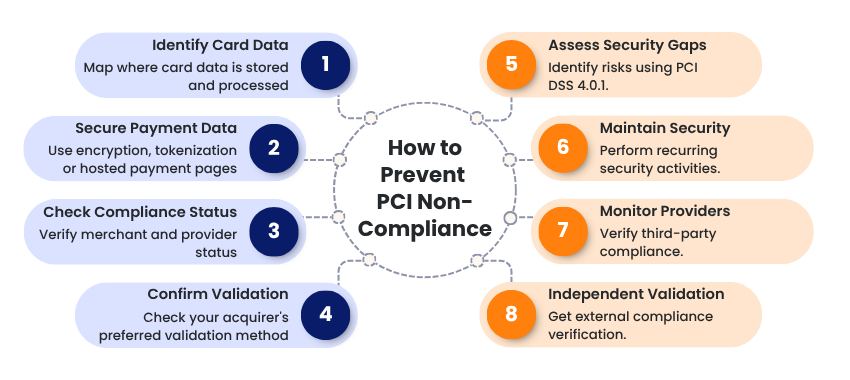
Work through these steps in order to make changes in your environment to achieve compliance. Implement them in the order listed below.
1. Identify where card data is stored, processed and transmitted across your environment, including the applications and service providers that handle it.
2. Keep card data out of your environment by using a PCI-listed P2PE solution, tokenization, or a hosted payment page.
3. Check the merchant’s or service provider’s level with your acquirer.
4. Determine which validation method your acquirer requires.
5. Use the PCI DSS v4.0.1 documents to assess gaps, prioritizing the most significant risks, including inadequate encryption, missing MFA, and a flat network.
6. Keep carrying out the quarterly ASV scans, log reviews and access reviews.
7. Oversee your service providers to ensure they are also compliant and have provided attestations of compliance.
8. QSA assessment is required for Level 1; Levels 2–4 usually self-assess unless the acquirer requires otherwise during the validation process.
Stay proactive with PCI DSS compliance through regular monitoring, service provider oversight and independent validation to protect cardholder data and maintain customer trust.
Get Independent Validation Before an Incident Forces It
PCI DSS compliance is more than a security requirement; it is an essential part of your strategy for securely capturing, storing, transmitting, and processing cardholder information. It also helps mitigate payment security risks and reassure customers. Whether you’re a merchant, payment processor, SaaS provider, or service provider, PCI DSS compliance demonstrates your commitment to secure payments.
Independent validation is the most cost-effective way to identify the corrective actions needed to address a deficiency before a card scheme organization or an attacker discovers it. Learn more about our PCI DSS Assessment Services and discuss your assessment requirements. Strengthen payment security and explore how INTERCERT can support your PCI DSS Assessment.


 +1 (281) 720-3261
 info@intercert.com
 2001 Timberloch Place - Suite 500, The Woodlands, Texas 77380, United States