


PCI DSS Encryption Requirements: What Businesses Must Know in 2026
Data breach reports regarding cards are concerning and yet show several troubling patterns. In particular, the compromised data was fully readable
Most incidents involving the theft or exposure of sensitive data result from a failure to encrypt that data. PCI DSS compriseso 12 requirements, with encryption addressed primarily in Requirements 3 and 4. Together, these requirements address the protection of cardholder data throughout its lifecycle, including data storage and transmission, while establishing guidelines for secure encryption and key management. PCI DSS specifies when data must be encrypted and provides guidance on protecting encryption keys.
This guide walks you through PCI DSS encryption requirements and the latest updates to the standard. It also highlights areas where organizations often fall short and helps you feel prepared to answer the challenging questions assessors may ask.
What Are PCI DSS Encryption Requirements?
The Payment Card Industry Data Security Standard (PCI DSS) is published by the PCI Security Standards Council (PCI SSC). These regulations apply to entities that store, process, or transmit cardholder data (CHD), as well as systems and processes that can affect the security of CHD.
There isn’t a dedicated "chapter" on encryption, but the relevant controls are primarily covered in Requirements 3 (security of stored account data) and 4 (security of cardholder data in transit). A few others appear in Requirements 2, 8, and 12.
PCI DSS 4.0.1, released in June 2024, remains the latest version. Transitional requirements from version 4.0 took effect on March 31, 2025. In June 2026, the PCI SSC sought comments on version 4.0.1 and began work on its successor. Until further notice, use version 4.0.1.
7 Core Encryption Requirements Under PCI DSS
The standard lists these functions in no particular order; we have reordered them for clarity and ease of use.
1. Protecting Data While It Moves Across Networks
When Primary Account Numbers (PAN) are transmitted over publicly accessible open networks, strong cryptography and secure protocols must be employed (Requirement 4.2.1). There should be no fallback to an insecure mode. A list of secure cryptographic protocols must be documented (Requirement 4.2.1.1). PAN must also be protected when transmitted, covering end-user messaging (Requirement 4.2.2). Other administrative access (i.e., non-console) must also be protected (Requirement 2.2.7).
2. Protecting Stored Data
PAN must be encrypted or otherwise rendered unreadable (Requirement 3.5.1). Sensitive Authentication Data (SAD) must not be stored after authorization purposes and encrypted (if stored at all) (Requirement 3.3.1). If PAN is displayed, it must be masked (Requirement 3.4.1).
3. Secure Handling of Cryptographic Keys
Requirements 3.6 and 3.7 mainly cover the security of cryptographic keys throughout their lifecycle. This includes, among other things, protecting the generation and distribution process, storage, cryptoperiods, replacement of compromised keys, split knowledge, dual control, and regularly reviewing individuals who have access to cryptographic keys. Real-world failures, which are addressed below, mostly occur at the key usage and control stages.
4. Adopting Robust Cryptographic Methods
PCI DSS uses the term “strong cryptography” to mean the use of cryptographic algorithms and processes in an effective and proper manner. Requirement 12.3.3 states that a corporation must evaluate and update the protocols and cipher suites used by the corporation each year. Authenticated data must be protected so that it cannot be read during transmission and/or stored on a system (Requirement 8.3.2).
5. Restricting Who Can Reach Encrypted Data
Encrypting data is of no benefit if the encryption keys are readily available to all persons. In fact, keys should be made available to as few persons as possible (Requirement 3.6.1.2). Additionally, if Req. 3.5.1.3 applies to disk-level encryption, the corporation uses full disk or partition encryption, system access and administration controls must be isolated from controls used to manage the encryption keys (Requirement 3.5.1.3).
6. Recurring Security Evaluations
Encryption must be viewed as a continuous process. Along this line of thinking, a corporation must review and evaluate the hardware and software in use every 12 months (Requirement 12.3.4) and confirm the PCI DSS scope every 12 months (Requirement 12.5.2). Annual vulnerability scans and assessments (Requirement 11) must also be performed.
7. Written Policies and Records
Access to and use of cryptographic keys, as well as the processes for key management, must be documented (e.g., how and why algorithms are chosen, who controls keys, key rotation, and key revocation). The PCI DSS requires service providers to describe their cryptographic architectures and provide assurances that separate production and test environments are not using the same encryption keys (3.6.1.1).
Which Cryptographic Standards and Protocols Does PCI DSS Accept?
The PCI DSS Glossary defines strong cryptography based on industry-tested and accepted algorithms, a minimum of 112 bits of effective key strength, and proper key-management practices. It recommends a minimum of 128 bits of effective key strength for all new implementations. Organisations should also follow recognised industry guidance, such as NIST recommendations, when selecting cryptographic algorithms and managing encryption keys.
Transport Layer Security (TLS) is widely used to protect data transmitted across networks. PCI DSS does not mandate a specific TLS version; however, SSL and early TLS, including TLS 1.0 and TLS 1.1, are not considered strong cryptography. TLS implementations must use modern cryptographic algorithms, secure configurations, and appropriate cipher suites to protect cardholder data in transit. NIST SP 800-52 provides additional guidance on selecting and configuring secure TLS implementations, although PCI DSS does not mandate compliance with this external publication.
7 Recommended Encryption Practices for PCI DSS
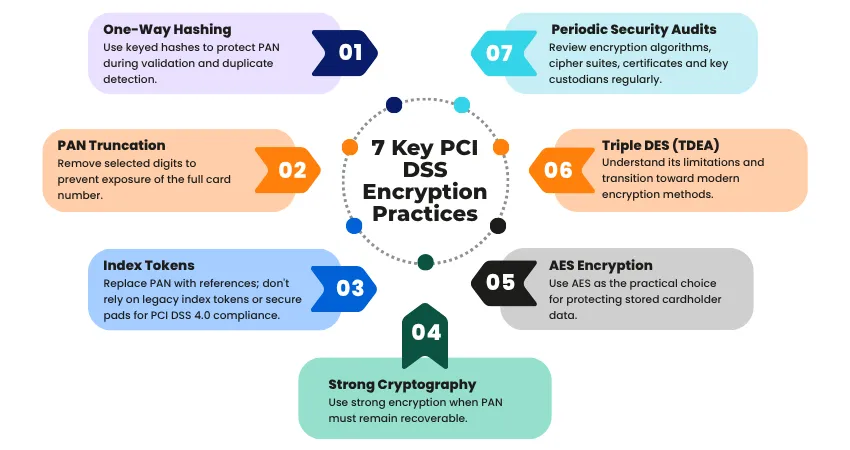
This section provides additional guidance for implementers of PCI DSS 3.5.1, which outlines methods for rendering PAN unreadable.
1. One-Way Hash Functions
If you are simply validating or removing duplicates, you can hash the PAN. As of March 2025, a keyed one-way hash is required (3.5.1.1). Unkeyed hashes, such as plain SHA-256, are insecure and can be brute-forced, especially when used to hash a credit card number. A highly compressed credit card number space makes reversal computationally feasible.
2. Truncation
Truncating a PAN removes part of the credit card number and, therefore, cannot be reversed. Truncation is used for temporary storage. Hashing and truncation cannot replace each other. If both hashing and truncation are applied to the same credit card number, additional controls should be implemented to ensure the two are not correlated.
3. Index Tokens and Securely Stored Pads
A reference to the PAN is replaced with an index. Earlier versions of the PCI DSS also included secure pads alongside index tokens. Neither index tokens nor secure pads should be relied on to meet PCI DSS 4.0 requirements.
4. Strong Cryptography
If the PAN needs to be reversible, such as when it must be decrypted, be sure to protect it with strong encryption.
5. AES Encryption
AES is the practical default choice for encryption and should be used when storing credit card data.
6. TDES/TDEA with Triple-Length Keys
Triple DES with extended-length keys is accepted by the PCI Council, though NIST also considers TDEA obsolete. In recent developments, AES has largely replaced TDEA.
7. Periodic Security Audits
Requirements 12.3.3 and 12.3.4 mandate audits of algorithms, cipher suites, certificates, and key custodians according to a prescribed schedule. These audits are intended to verify compliance with PCI DSS provisions.
How Does Encryption Narrow Your PCI Compliance Scope?
PCI DSS applies to entities that store or process cardholder data. Systems and entities that could adversely affect the security of cardholder data also fall within the scope of PCI DSS.
Encrypting cardholder data can help reduce PCI DSS scope when implemented as part of an eligible solution, such as a PCI DSS-validated Point-to-Point Encryption (P2PE) solution. However, encryption alone does not remove systems from scope, and decrypting cardholder data can bring previously excluded systems back into scope. Validation requirements depend on your merchant or service provider category; see our PCI DSS Levels guide for details. To better understand and take a more holistic approach, follow this link to PCI DSS Compliance: A Complete PCI DSS Guide for Businesses
Encryption or Tokenisation: Which Strategy Fits Your Needs Better?
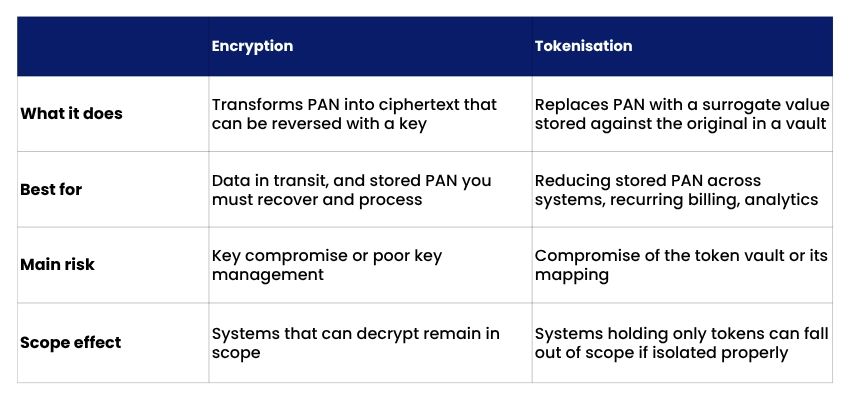
Most organizations employ both encryption and tokenization. Data is encrypted in transit, while tokenized data receives an additional layer of protection. Data that must be retained is encrypted.
Why Is Key Management the Most Overlooked Part of PCI Encryption?
Most organizations focus on developing and implementing complex encryption algorithms. However, the control is compromised if a key is stored with the data it protects or if too many people who are responsible for managing the keys have access to it.
To manage key storage, it should be protected by a cryptographic device. It is important to have a procedure to manage the lifecycle of keys and other cryptographic devices. The procedure should be regularly tested. These practices help demonstrate good control to auditors.
3 Common Challenges in Meeting PCI DSS Encryption Requirements
1. Tracking Changing Encryption Standards
As a good practice, organisations should monitor updates to NIST guidance and PCI SSC FAQs to stay informed about changes in encryption recommendations and requirements.
2. The Complexity of Managing Keys
The use of multiple cryptographic keys by various vendors and services can result in chaotic distribution and management of keys. The use of a managed key service can reduce this.
3. Connecting Encryption to Older Systems
Cryptographic acceleration can be implemented to offload system demand, but if the system is very old and slow, it may not be able to support strong encryption.
What Happens If Your Business Falls Short of PCI Encryption Requirements?
The PCI Standards Council does not impose penalties for noncompliance. Instead, your acquiring bank and the card brands determine the consequences, which may include fines passed on by the acquirer, higher transaction fees, or losing the ability to process card payments. The terms and conditions of your merchant agreement outline these consequences.
There are broader implications of a failed control beyond PCI DSS. The loss of customers’ trust because sensitive data was exposed and protected by ineffective controls is always a concern. This includes data protection laws and regulations such as the GDPR. Encryption is one example of an adequate level of security under the GDPR.
What Happens If Your Business Falls Short of PCI Encryption Requirements
This can result in the loss of cardholder data, a high risk of data breach, non-compliance, and a reduction in consumer trust. To protect payment data, encryption must be extremely strong, along with secure key management and periodic assessment.
PCI DSS compliance is more than a requirement. It helps build business trust and reinforces the commitment to protecting customers' data. INTERCERT is a one-stop solution that helps organizations assess security controls against PCI DSS requirements and, in particular, strengthen their payment data protection practices.
Contact us to understand the agile approach towards the PCI DSS compliance requirements.


 +1 (281) 720-3261
 info@intercert.com
 2001 Timberloch Place - Suite 500, The Woodlands, Texas 77380, United States