


Vulnerability Assessment and Penetration Testing (VAPT): Explained

In today’s fast-paced, tech-dependent world, we usually hear about companies falling victim to cyberattacks and data breaches daily.
These incidents leave them with severe issues like financial loss, damaged reputations, and sometimes angry customers. To prevent this, businesses constantly look for ways to keep their sensitive information safe. In this blog, we explain what VAPT is, why it matters, its types, and how it can help secure your business’s future.
What is VAPT?
VAPT, or vulnerability assessment and penetration testing, helps identify potential vulnerabilities in an organization’s systems and assess the risks of exploiting them. Vulnerability assessments are the first stage of VAPT, helping uncover potential security gaps. Penetration tests assess how those vulnerabilities could be exploited and answer the question, “How much worse can it get?”
What is a vulnerability Assessment?
A vulnerability assessment identifies potential security weaknesses in an organization’s IT assets and systems. Automated tools and techniques help uncover issues such as outdated software, poor configurations, weak access controls, and insecure security settings.
A vulnerability assessment produces a comprehensive list of potential security flaws, typically ranked by severity. This helps an organization’s security personnel prioritize and manage remediation efforts.
What is a Penetration Test?
A penetration test (also known as a pen test) is an authorized, controlled evaluation of an organization’s IT systems and infrastructure conducted by ethical hackers. Its purpose is to identify potential security vulnerabilities and assess the associated risks. Compared with vulnerability assessments, penetration tests reveal where attackers could go, what they could access, and which actions best mitigate business and security risks.
Why is VAPT Important?
Vulnerability assessment and penetration testing (VAPT) is a proactive security evaluation that combines vulnerability assessments (VA) with penetration testing (PT). VA helps an organization identify the potential vulnerabilities in a system, while PT determines whether those vulnerabilities are present and exploitable. VAPT helps organizations prioritize security resources in ways that reduce business risks and potential liabilities.
Find Weaknesses Before Attackers Exploit Them
Threat actors continually assess and inventory systems to identify exploitable vulnerabilities. Organizations should adopt similarly proactive approaches to vulnerability assessment and remediation to address these issues before they can be exploited.
Turn Test Findings into Clear Security Priorities
Vulnerabilities can occur at multiple levels, making it difficult to decide which to address first. Through its testing methodology, VAPT provides insight into potential threats to the organization and helps prioritize remediation efforts. It also reduces the need to rely on long, cumbersome, and often unmanageable lists of issues to resolve.
Confirm That Flaws Are Exploitable in Practice
Not every vulnerability flagged by a scanner poses a real risk. The best way to determine whether it does is to test it as an attacker would. Penetration testing can uncover risks hidden by false positives.
Meet and Sustain Regulatory Requirements
ISO 27001, PCI DSS, SOC 2, and regulations issued by the RBI, SEBI, and CERT-In require security controls to be evaluated and tested consistently. VAPT helps identify vulnerabilities and also supports a client’s audit readiness.
Lower the Chance of Business Interruption
When a business can’t provide its services, it risks losing customers’ trust and revenue. VAPT helps reduce the risk of incidents, including outages.
Improve cybersecurity confidence with comprehensive VAPT Services from INTERCERT.
Types of VAPT
INTERCERT offers a comprehensive range of VAPT services to identify and address security vulnerabilities across multiple platforms. These services help organisations strengthen the Network Vulnerability Assessment
This assessment helps identify security gaps and access control issues across network devices, servers, and applications. It also identifies publicly accessible services and hidden or open ports on the assessed network devices.
1. Host Vulnerability Assessment
This assessment focuses on end-user devices, including laptops, workstations and other endpoint devices. This assessment identifies vulnerabilities due to software and firmware version control issues and misconfigurations.
2. Web Application Vulnerability Assessment
This assessment helps in determining the security posture of web applications and identifies security flaws leading to cross-site and/or scripting injection attacks.
3. Mobile Application Vulnerability Assessment
This assessment reviews mobile applications’ security and helps identify vulnerabilities that could lead to unauthorized access or the transmission of data without proper encryption.
4. API Vulnerability Assessment
This assessment identifies access control and authorization flaws with APIs and determines potential risks due to exposure of sensitive data.
5. Database Vulnerability Assessment
Analyzes databases for exposed or easily guessed credentials, excessive permissions, and other configuration issues.
6. Wireless Network Vulnerability Assessment
Evaluates the security of wireless networks. Analysis may include detection of rogue access points and wireless network attacks. The use of Network VAPT can ensure and diminish the vulnerability attack.
7. Physical Security Vulnerability Assessment
Inspects, on-site, entrances and access controls, and protects servers and other critical IT infrastructure.
8. Source Code Analysis
Evaluates application source code for vulnerabilities. Analysis may be done at various stages of development and may include static and dynamic analysis.
9. Cloud Security Vulnerability Assessment
Understands cloud environments such as AWS, Azure, and GCP to identify misconfigurations, risks, and policy gaps.
10. Firewall Security Assessment and Configuration Review
Audits firewall rules and settings to ensure they block threats without leaving unintended openings.
11. Docker Vulnerability Assessment
Scans container images, configurations, and runtime environments for vulnerabilities and insecure practices.
12. IoT Vulnerability Assessment
Checks most IoT devices and connected devices that need to ensure their firmware, communication, and interfaces are free of security weaknesses.
What is the Process of VAPT?
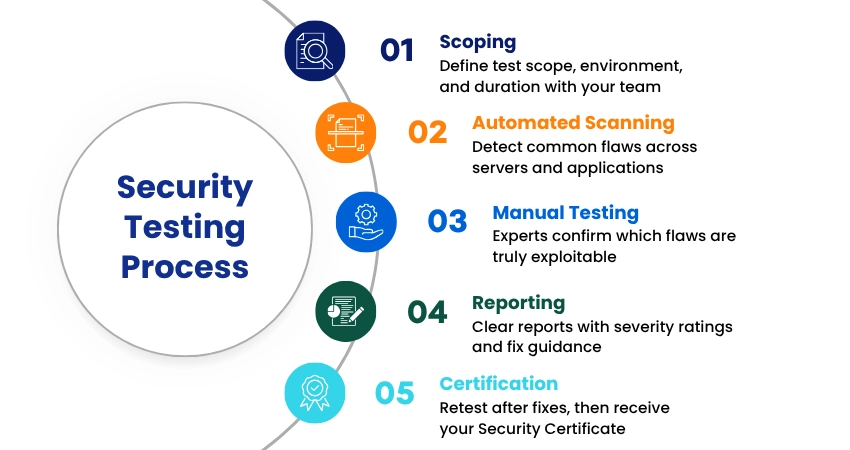
The VAPT process not only assesses the security of your systems but also ensures that testing is conducted systematically and according to a defined plan. At INTERCERT, the VAPT process comprises five activities, ranging from analysis to certification.
Step 1. Scoping
Before starting any test, we understand your requirements and define the scope of the test to be conducted. In conjunction with your team, we identify the test components, the test environment, constraints, and test duration. This step also helps to maintain the integrity of the test components and live systems.
Step 2. Automated Scanning
In this step, we assess the components identified in the analysis using automated tools to detect common security flaws. The use of Vulnerability Scanning can examine the servers and network applications to identify potential security threats and identify the weakness in the application server infrastructure.
Step 3. Manual Testing
Tools have limited capabilities and may not detect sophisticated vulnerabilities. Drawing on their experience and domain expertise, our professionals assess whether the security flaws identified by these tools are exploitable in practice.
When a vulnerability can be exploited to gain unauthorised access to a system, a compromise may occur. In such cases, business logic may allow unauthorised access to a system and is considered a flaw.
Step 4. Reporting
We compile all findings into clear, easy-to-follow reports. These reports are designed to serve all audiences, from the C-Suite to technical staff, and include, where appropriate, screenshots and/or proofs of concept, findings and severity ratings, as well as instructions for remediation.
Step 5. Certification
Upon completion of remediation, INTERCERT conducts retesting to confirm that the issues have been resolved. Once remediation has been verified, INTERCERT provides the Customer with a Security Certificate, demonstrating the Customer's commitment to information security to Clients and other stakeholders, including Auditors and Regulatory Authorities.
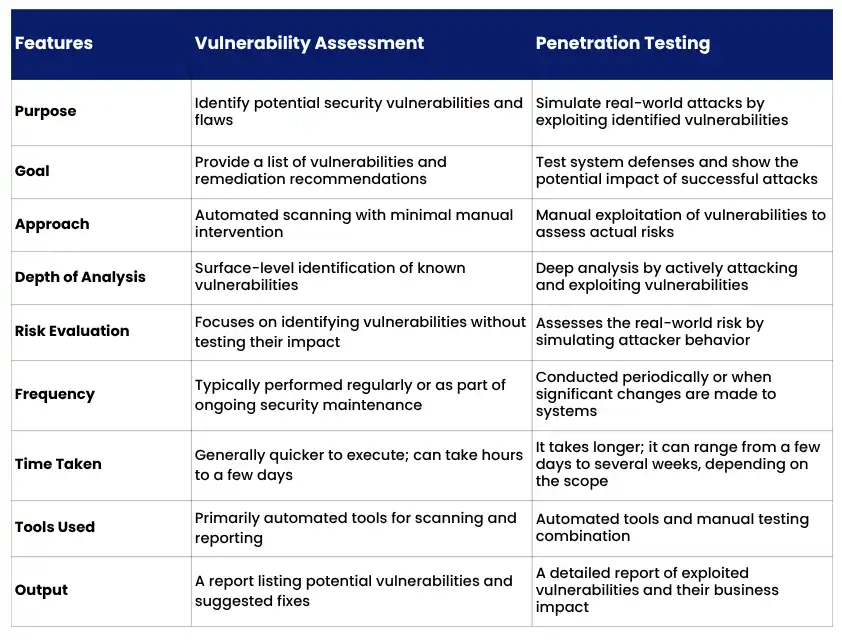
Difference Between Vulnerability Assessment and Penetration Testing
Which VAPT Service Provider is The Best Fit For You?
Choosing the most reliable VAPT partner determines the utility of the assessment results. A partner needs to have strong knowledge of tools and implementation experience, but to get the most from the assessment, it is essential to comprehend the business outcomes, insightful recommendations and planning based on the detailed findings. Below, we are going to discuss a few points that will give a better brief on how a VAPT service provider can be the best fit for you:
1. Assess Your Security Requirements
First, determine what requires protection and the rationale for protecting it. Identify the components to be assessed (i.e., applications, networks, cloud environments, and/or other devices), and specify the frameworks, standards, and regulations (i.e., ISO 27001, PCI DSS, SOC 2, CERT-In, etc.) with which compliance is required. The partner you select should be equipped to address your needs and support you in achieving your objectives.
2. Ensure Methodological Depth
Understand the approaches and techniques the partner will use to conduct the assessment. The partner should adopt an integrated approach, using automated tools for preliminary assessment and validation and supplement this with a comprehensive manual assessment based on OWASP, NIST and/or PTES.
3. Emphasize Clear and Open Communication
The partner should be able to communicate in clear, simple language. The partner should be able to explain the assessment scope, timeline and potential risks to you. During the assessment, you should be notified of any critical issues. Assessment reports should be easy for non-technical readers to understand and should not contain technical jargon.
4. Look for Value, Not Just Cost
Most organizations compare quotes based on cost. However, you should look at what’s included with the quote and compare the following to determine depth of service: manual testing, reporting and certification.
5. Consider Post-Assessment Support
Vendor support and service after an assessment can help an organization address and remediate vulnerabilities quickly. Ideally, the vendor should offer support and service to answer questions and help the development team understand remediation and validate fixes through retesting.
6. Check for Relevant Expertise and Experience
Request case studies and client testimonials, and research the team to gauge their experience with similar industries and technology. It’s also advisable to evaluate the team’s individual professional certifications.

Example of VAPT
Vulnerability assessment and penetration testing (VAPT) is applied across industries and technologies to identify real-world risks. The following are several common examples:
Web Application Testing for an E-commerce Platform
Testers identified several vulnerabilities in various scenarios, including an SQL injection vulnerability on an e-commerce company’s checkout page that could have enabled an attacker to access customers’ personal and financial information. The vulnerability was remedied before the testers lost confidence in the organization.
Mobile Banking App Assessment
The mobile banking application stored customer data and banking credentials in an unencrypted format on the device. As a result, the testers lost confidence in the application and recommended that management engage the development team to encrypt the data and secure its transmission.
Cloud Infrastructure Testing
We identified a misconfiguration that permitted third parties to access files stored in our cloud environment. These files contained sensitive information. The misconfiguration has been corrected, and the risk of a data leak has been eliminated.
Network Penetration Testing (Corporate Office)
Testers gained access to an unpatched server and used it to access other servers on the internal network. The company used the findings to apply server patches and reconfigure its network to better protect internal systems.
API Testing (FinTech App)
API tests uncovered a misconfiguration that allowed users to access another user’s transaction data. The company modified its API to restrict unauthorized access.
Examples are representative and generalized. Provide case studies if available. I can add a closing statement (i.e., "Talk to our experts to learn more")
Conclusion
Cyberattacks are inevitable; without systems to detect and prevent them, organizations risk lost revenue, reputational damage, and noncompliance. VAPT in cybersecurity offers a better alternative, helping you understand your organization’s vulnerabilities and how they could potentially be exploited.
Regular VAPT assessments help organizations address vulnerabilities and deficiencies in their information security management systems and, ultimately, achieve and maintain compliance with various standards, regulations, and frameworks, including ISO 27001, PCI DSS, SOC 2, and CERT-In.
At INTERCERT, we employ both automated and manual testing to develop a comprehensive understanding of vulnerabilities and potential threats. We provide VAPT services for on-premises and cloud environments. Please contact us to speak with our security experts and learn more.
Read More:
Embedding Penetration Testing Into CI/CD for Indian Firms




 +1 (281) 720-3261
 info@intercert.com
 2001 Timberloch Place - Suite 500, The Woodlands, Texas 77380, United States