
ISO/IEC 27001:2022 Information Security Management Systems
Information Security Management Systems


Data privacy and security are top priorities for individuals when choosing who to trust with their information. With a securely managed data the organization can build trust and compliance. The Personal Information Protection and Electronic Documents Act (PIPEDA) sets the standard for how businesses operating in Canada must handle personal data. INTERCERT offers PIPEDA compliance assessment services to meet these requirements and ensure strong data privacy practices.
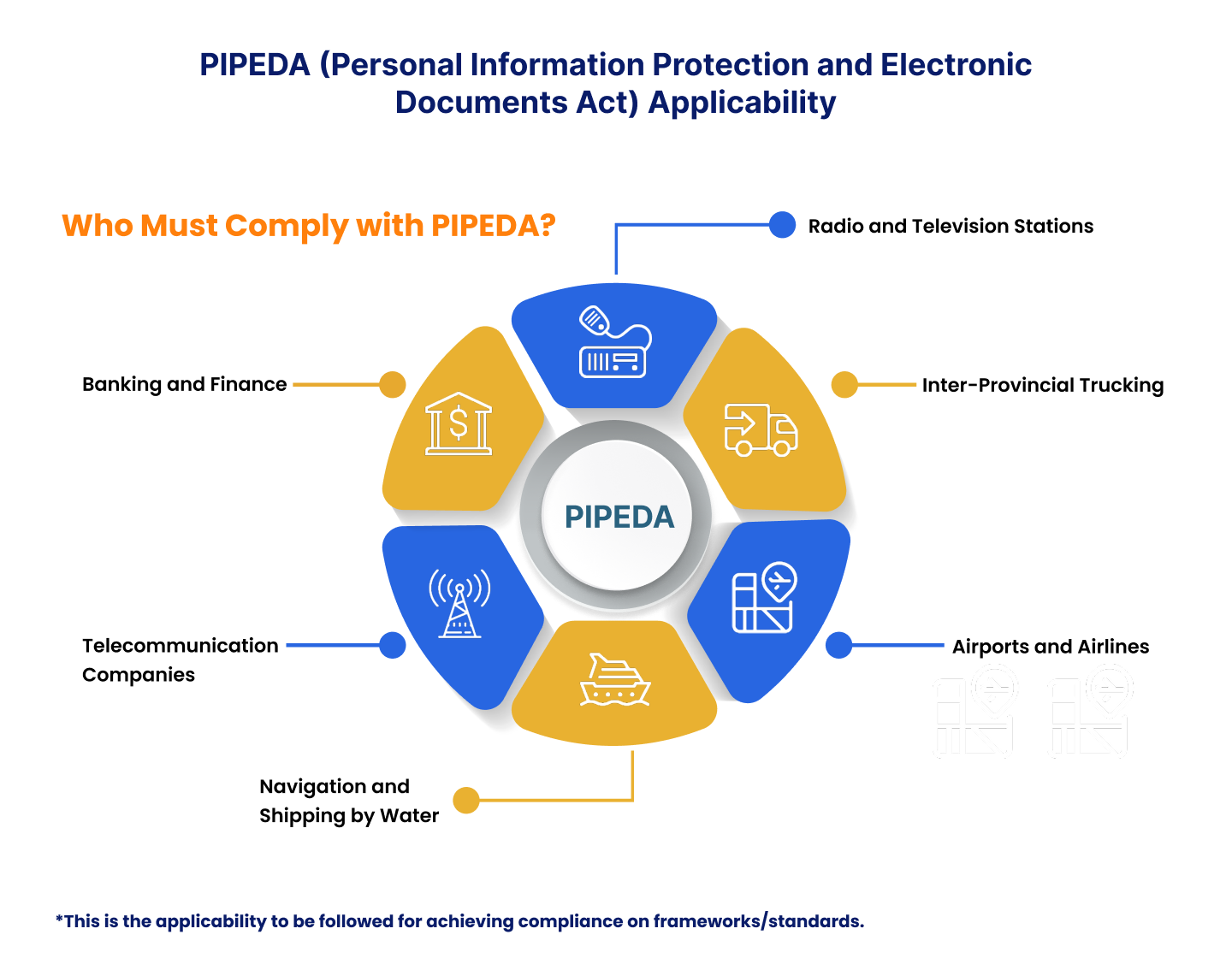
The Personal Information Protection and Electronic Documents Act (PIPEDA) is a Canadian federal law that governs how private sector organizations collect, use, and disclose personal information during commercial activities. PIPEDA aims to balance individuals' right to privacy with the need for organizations to collect and use personal information for legitimate business purposes. It applies to all organizations operating in Canada, except in provinces with similar privacy legislation.
Here is a general overview of the key steps your organization should follow to achieve PIPEDA compliance:

Conduct an initial assessment to determine whether the current process meets the requirements of standards or frameworks.
Identify the scope to understand inclusions and exclusions, which establishes boundaries, supports, goal achievement, and a clear path to achieving success.
Ensures a streamlined workflow, aligning processes to achieve goals while maintaining efficiency and quality.
Identify, develop, and implement solutions to meet requirements, improving and optimizing them to remain effective and aligned.
Provide training to boost skills, awareness, and understanding of handling tasks, managing risks, and applying the best methods to improve the process and requirements of the standard or framework requirements.
Conduct an audit to examine compliance with standards or framework requirements and provide an assessment report that includes compliance evaluation and improvement areas.
Ensure constant process improvement to enhance outcomes and drive efficiency and overall performance.

Understanding of Business Context
Confirmation of Audit Scope
Assignment of Auditor (CISA/CIPP/CIPM Certified)
Preparation of Audit Plan

Opening Meeting
Confirmation of Scope
Collection of Evidence
Closing Meeting

Preparation of Draft Report
Client approval on Draft Report
Delivery of final report attested by the CISA/CIPP/CIPM certified Auditor
Accountability: Organizations are responsible for the information they store and must appoint someone to ensure compliance with the ten principles.
Identifying Purposes: Organizations must clearly state the purposes for data collection before or at the time of collection.
Consent: Organizations must obtain meaningful consent to collect, use, and share personal information.
Limiting Collection: Only information necessary for identified purposes should be collected.
Limiting Use, Disclosure and Retention: Personal data must only be used or disclosed for stated purposes unless additional consent is obtained.
Accuracy: Organizations must ensure personal information is accurate, complete, and up to date.
Safeguards: Appropriate security measures must be implemented to protect personal information.
Openness: Organizations must be transparent about their data handling practices.
Individual Access: Individuals have the right to access, review, and correct their personal information.
Challenging Compliance: Individuals can challenge an organization’s compliance with these principles.
Protect your business from penalties and legal issues.
Strengthen customer loyalty with transparent practices.
Improve your reputation in the marketplace with responsible data use.
Stay ahead of competitors by showing you value privacy.
Reduce risks and avoid privacy-related losses.



 2001 Timberloch Place - Suite 500, The Woodlands, Texas 77380, United States
©2026 Intercert. All Rights Reserved


 +1 (281) 720-3261
 info@intercert.com