
ISO/IEC 27001:2022 Information Security Management Systems
Information Security Management Systems


NIST 800-171 (National Institute of Standards and Technology Special Publication 800-171) In government contracting and beyond, protecting Controlled Unclassified Information (CUI) is paramount. The National Institute of Standards and Technology (NIST) Special Publication 800-171 provides guidelines for safeguarding CUI in non-federal systems and organizations. INTERCERT offers NIST 800-171 compliance assessment services to achieve these requirements and enhance data security practices.
NIST SP 800-171 sets the rules for Controlled Unclassified Information (CUI) outside federal systems. It’s about protecting the sensitive unclassified data. It focuses on confidentiality, integrity and availability. These requirements make sure CUI doesn’t fall into the wrong hands. Whether it’s stored, shared or processed. This framework keeps it under control. Clear, structured and essential for any non-federal organization dealing with government data.
Here is a general overview of the key steps your organization should follow to achieve NIST 800-171 compliance:

Conduct an initial assessment to determine whether the current process meets the requirements of standards or frameworks.
Identify the scope to understand inclusions and exclusions, which establishes boundaries, supports, goal achievement, and a clear path to achieving success.
Ensures a streamlined workflow, aligning processes to achieve goals while maintaining efficiency and quality.
Identify, develop, and implement solutions to meet requirements, improving and optimizing them to remain effective and aligned.
Provide training to boost skills, awareness, and understanding of handling tasks, managing risks, and applying the best methods to improve the process and requirements of the standard or framework requirements.
Conduct an audit to examine compliance with standards or framework requirements and provide an assessment report that includes compliance evaluation and improvement areas.
Ensure constant process improvement to enhance outcomes and drive efficiency and overall performance.

Understanding of Business Context
Confirmation of Audit Scope
Assignment of Auditor (CISA Certified)
Preparation of Audit Plan

Opening Meeting
Confirmation of Scope
Collection of Evidence
Testing of control implementation & Effectiveness
Closing Meeting

Preparation of Draft Report
Client approval on Draft Report
Delivery of final report attested by the CISA certified Auditor
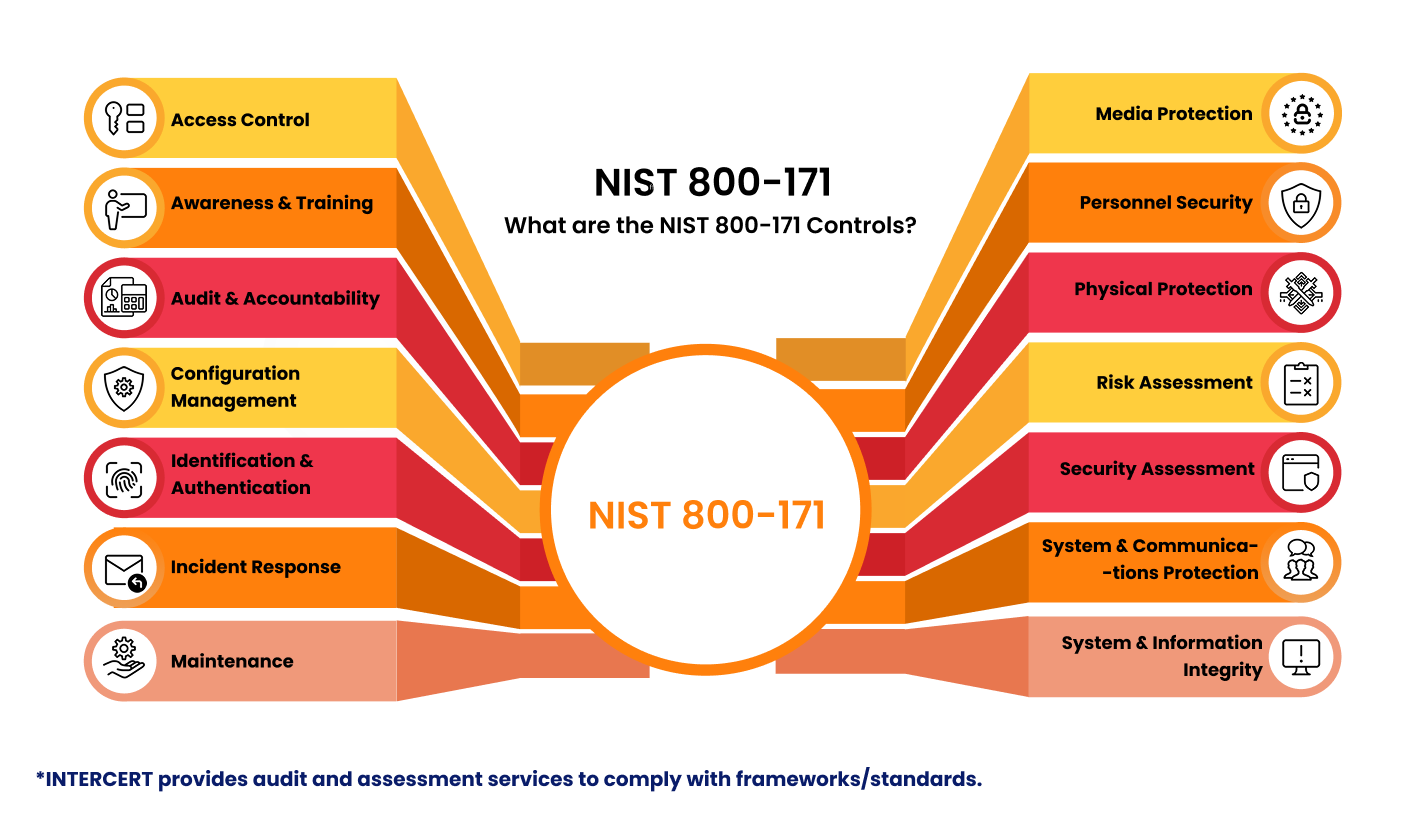
To comply with NIST 800-171, organizations must protect Controlled Unclassified Information (CUI) across 14 areas. Here’s a straightforward breakdown:
Limit CUI access so only authorized people and devices can view or use it. This applies to computers, servers, firewalls, and everything on your network.
Educate employees on cybersecurity best practices. Training helps them recognize risks like phishing or insider threats and know their role in protecting data.
Keep detailed logs of system activities. Audit trails show who accessed CUI, when and to trace the actions and show accountability.
Set secure baseline settings for all hardware and software. Update and maintain these configurations regularly to stay protected.
Verify every user, device, or process before granting access. Use strong methods like passwords, biometrics or multi-factor authentication.
Have a plan ready for cyber incidents. Your team should detect, analyze, contain, and recover quickly, while keeping proper records of the event.
Regularly maintain systems and applications to ensure they stay updated and secure against new threats.
Secure removable media like USBs, drives, or CDs that contain CUI. Control who can use them, and ensure they are safely wiped or destroyed when no longer needed.
Screen staff before granting them access to sensitive data. Also, make sure departing employees no longer have access to CUI.
Safeguard the physical locations where systems or files are stored. Use locks, PIN codes, or biometric systems to prevent unauthorized entry.
Carry out regular risk assessments to identify the biggest threats to your data, such as phishing or ransomware, and address them effectively.
Review and test your security controls often to check if they’re working as intended and update them when needed.
Protect data moving across your systems and networks. Use encryption and secure channels to prevent unauthorized interception.
Continuously monitor systems for flaws, malware, or unusual activity. Respond quickly to alerts and fix issues to keep systems trustworthy.
Strengthens security management within an organization with a trusted and standardized framework.
Improves supply chain security by establishing trust in the marketplace.
Reduces operational costs by streamlining security processes.
Enhance trust and transparency with cybersecurity governance.
Improves risk management and compliance tracking.
Ensures seamless operations by minimizing downtime.



 2001 Timberloch Place - Suite 500, The Woodlands, Texas 77380, United States
©2026 Intercert. All Rights Reserved


 +1 (281) 720-3261
 info@intercert.com