
ISO/IEC 27001:2022 Information Security Management Systems
Information Security Management Systems


The Digital Personal Data Protection Act (DPDP 2023) addresses the challenges related to unregulated and misuse of data. The DPDP Act establishes clear rules for collecting, processing, storing, and sharing personal data. Effective DPDP data protection helps safeguard individuals from identity theft, financial fraud, and unwanted profiling. For organizations, weak data governance can lead to legal trouble, operational problems, and a loss of customer trust. It ensures that organizations adopt robust consent management, security safeguards, and accountability frameworks.
INTERCERT enables organizations to navigate the DPDP Act compliance journey with a structured and risk-based approach. We provide end-to-end DPDP Act compliance solutions that ensure your business protects individuals’ privacy, manages regulatory risks, and builds trust in the digital era. Our DPDP Act compliance solutions are designed to scale with your organization and evolve alongside regulatory updates.
The Digital Personal Data Protection Act, 2023 (DPDP Act), is India’s first privacy and data protection legislation enacted to regulate the processing of personal data in the digital economy. It aims to protect people’s privacy while still allowing businesses to use data responsibly for innovation and better services. The DPDP Act came into force in phases beginning 13 November 2025, with full implementation continuing through 2027. Unlike some international privacy laws, the DPDP rules take a relatively flexible approach to cross-border data transfers. Personal data may generally be transferred outside India unless restricted by government-notified countries or entities. In comparison, the GDPR places broader restrictions on transfers outside the European Economic Area, allowing them only when strict conditions under Chapter V are met.
Under DPDP, individuals are known as Data Principals, while organizations processing their data are Data Fiduciaries. The Act defines how personal data must be handled, and grants individuals control over their information.
Organizations often rely on a DPDP Act compliance checklist to structure and track these activities. Effective DPDP Act compliance requires a combination of governance, technical controls, and ongoing oversight:

Conduct a thorough initial assessment by reviewing data handling practices, privacy documentation, and security controls, and identify risks and prioritize compliance actions.
Determine your organisational s scope under DPDP, including whether you qualify as a Significant Data Fiduciary, with added responsibilities like appointing a DPO and conducting regular impact assessments.
Develop and regularly update core governance documents such as privacy notices, consent frameworks, data retention policies, and incident response procedures to meet statutory requirements and clearly explain how personal data is used and protected.
Implement robust security controls like encryption, role-based access, network monitoring, and secure storage, while integrating privacy principles at every stage.
Train employees and stakeholders on privacy responsibilities, consent, breach reporting, and individual rights, making privacy an integral part of your organization’s culture.
Regularly review your systems and processes through compliance audits and DPIAs to ensure they stay aligned with evolving DPDP requirements.
Establish mechanisms to measure, report, and improve compliance over time. This includes governance reports to leadership, internal control reviews, and adapting to regulatory updates and rule notifications.
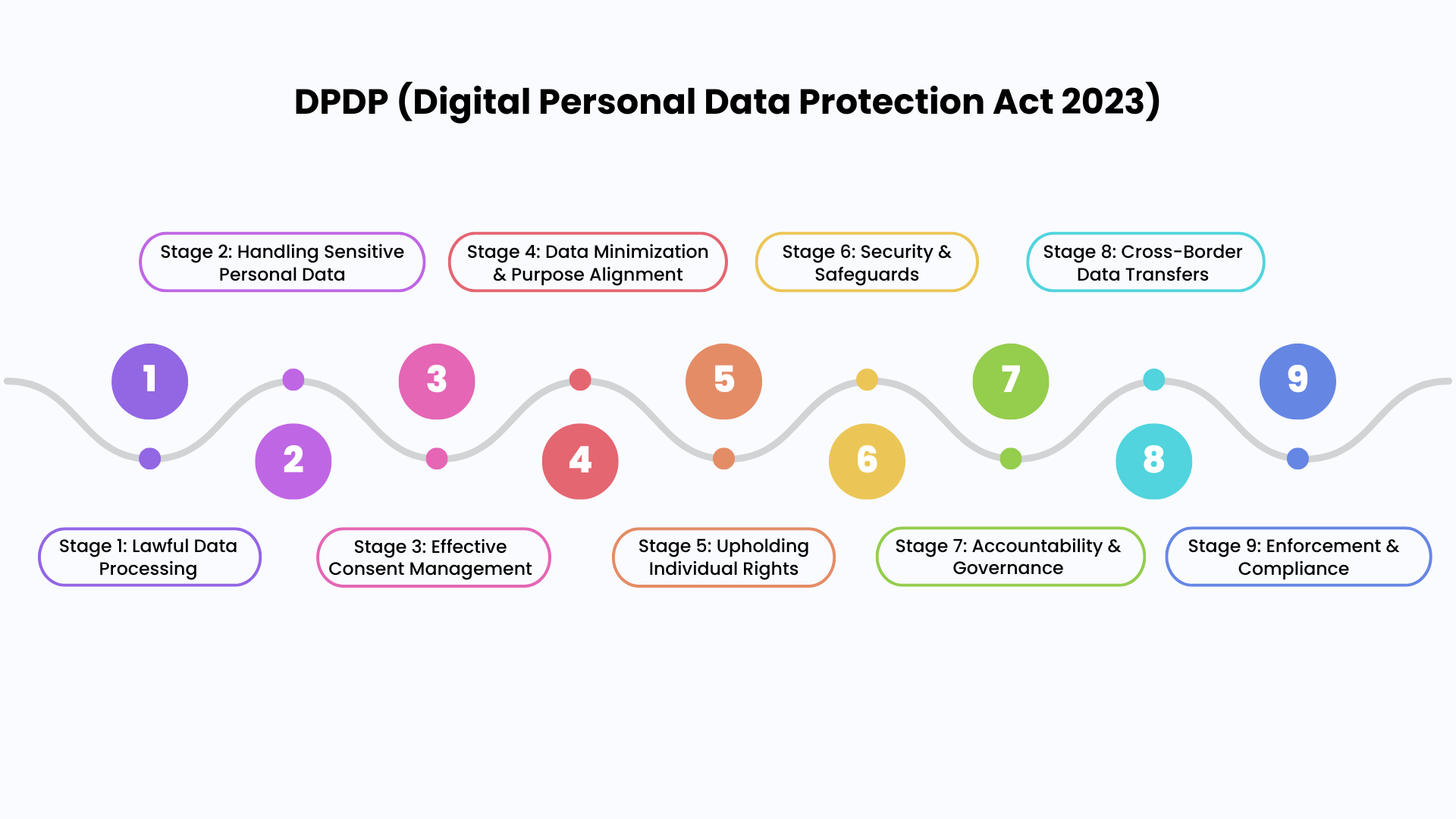
Personal data must be collected and used fairly and transparently. Organizations should clearly inform individuals why their data is being collected and obtain consent where required. The data should only be used for the purpose for which it was collected.
Sensitive data such as health, financial, or biometric information requires stronger protection. It should only be collected with explicit consent and handled with additional safeguards, especially when transferred outside India.
Consent must be clear and voluntary. Individuals should understand what they are agreeing to and must be able to withdraw consent at any time. Organizations should also keep records of consent for compliance purposes.
Only the minimum necessary data should be collected. Organizations should not use personal data for new or unrelated purposes unless fresh consent is obtained.
Individuals must be able to access, correct, or request deletion of their data. Processes should allow people to exercise control over their personal information easily.
Organizations should implement security measures such as access controls, policies, and monitoring to protect personal data. Any data breach should be reported as required.
A responsible authority or Data Protection Officer should oversee compliance. Organizations must maintain records, assess risks, and integrate privacy into their processes.
When data is transferred outside the country, it must remain protected and follow government-specified conditions.
Organizations should follow directions from the Data Protection Board, understand penalties, and regularly review their practices to stay compliant.

Define audit scope clearly
Set audit objectives
Identify personal data sets
Determine compliance metrics
Prepare audit plan and timeline
Assign audit team roles

Check consent mechanisms
Review privacy notices
Assess security controls and risk management
Evaluate data lifecycle and retention policies
Verify rights fulfilment
Screen third-party vendors

Document audit findings
Highlight risk exposures
Define remediation actions
Prepare audit report
Issue compliance attestation
Retain evidence securely
Improves DPDP data protection practices and reduces the risk of data breaches or misuse.
Builds customer trust through transparent data handling practices.
Strengthens privacy practices and enhances business credibility.
Reduces potential legal penalties and financial exposure.
Supports alignment with global data protection expectations.
Promotes long-term customer confidence and organizational resilience.



 2001 Timberloch Place - Suite 500, The Woodlands, Texas 77380, United States
©2026 Intercert. All Rights Reserved


 +1 (281) 720-3261
 info@intercert.com