


ISO 42001 vs ISO 27001 for SaaS Companies: Key Differences and When You Need Both
In recent years, the security-related questions posed by SaaS clients have evolved. Inquiries about access controls, incident response, and encryption are now accompanied by-and sometimes replaced by- questions about the models used in a SaaS solution and the data used to train them. Clients also seek to understand who, or which organization, validates the model outputs. Additionally, they are concerned about model drift and the possibility that their data may be combined with other data used to train a model beyond their control.
Although ISO 27001 certification provides a strong foundation for information security, it may not address every client concern. ISO 27001 and ISO 42001 are increasingly important for managing information security and AI risks.
This document explains how the standards compare and helps you determine when each is appropriate. First, let’s examine the key differences between ISO 42001 vs ISO 27001.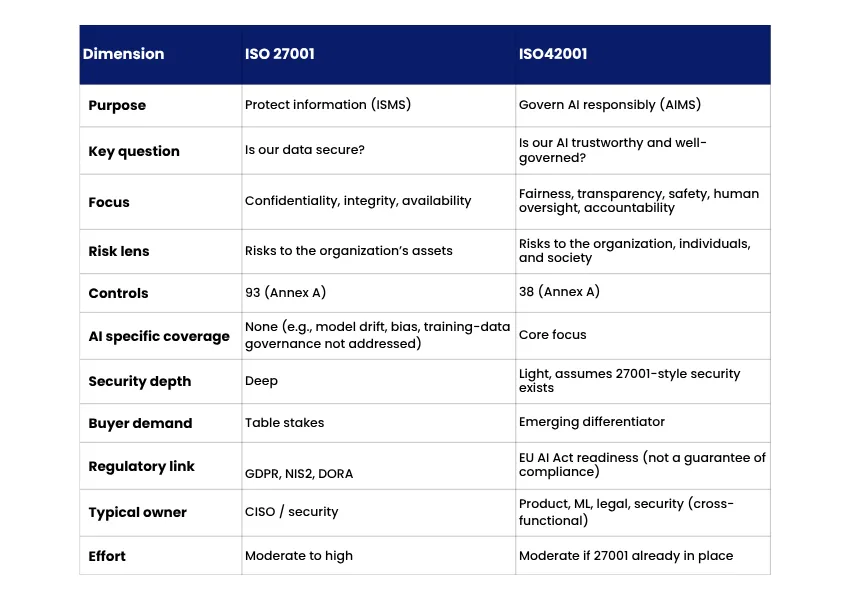
Should a SaaS Company Get ISO 27001 Before ISO 42001?
The two standards were specifically developed for different bodies and therefore address different areas.
ISO/IEC 27001 is a standard that helps organizations develop and implement a management system to control and govern the information security processes of the organization. It was last published in October 2022.
ISO/IEC 42001, published in December 2023, is the first standard in the area of management systems for the responsible use of Artificial Intelligence (AI). It seeks to help organizations manage the risks and impacts associated with AI systems and addresses accountability, data and other concerns of affected stakeholders.
This is a key distinction for a SaaS company: ISO 27001 protects information assets, while ISO 42001 provides a framework for managing artificial intelligence (AI) and addressing related risks and opportunities throughout the AI lifecycle. Unexplained biases can still arise in AI, even when strong security controls are in place during its development. ISO 27001 doesn’t address safeguards against undesirable AI behavior, while ISO 42001 does.
An ISMS manages risks associated with malicious actors, whereas an AIMS manages risks associated with AI. In general, an AI-based SaaS company will require both. For further information on AI, see our ISO 42001 Certification Guide.
Where ISO 27001 and ISO 42001 Overlap in a SaaS Environment?
ISO 27001 is not a prerequisite for ISO 42001; however, many SaaS companies obtain it first, as the standard encompasses a broad range of security and assurance controls, some of which are relevant to AI governance programs.
Although ISO 42001 doesn’t explicitly require ISO 27001, you might consider postponing ISO 42001 if AI governance isn’t yet integrated into your product and you’re receiving questions about it. We’ll explore this scenario later in the article.
ISO 27001 and ISO 42001 Alignment in the SaaS Model
You probably already have parts of an ISMS without even realizing it. Both systems overlap significantly, especially in the areas of management and processes. Some examples are as follows:
- Context and Scope - In both cases, you need to describe the interested parties, as well as the scope and boundaries of your organization.
- Leadership and Management - In both cases, management must provide a statement of commitment and establish a policy, which may address information security or artificial intelligence.
- Risk - This overlaps with risk assessment and treatment, and includes a statement and criteria for determining the extent of control.
- Improvement- Management reviews, internal audits and continual improvement.
The overlap between ISO 42001 vs ISO 27001 is mainly in the management-system clauses (context, leadership, risk, audit, review). Some Annex A topics, such as incident handling and logging, are related but not identical. Each document addresses a different subject, yet the frameworks and foundations of the standards remain the same.
Where Does Your SaaS Platform’s AI Governance Stand Today?
Before going any further, it is essential to understand and evaluate the actual situation and where the SaaS platform’s AI governance stands. Some questions to consider are:
- Are the datasets used to train and tune the models documented?
- Are the models evaluated to determine whether the datasets used for training and/or tuning are legally and/or ethically justifiable?
- Is the potential impact on end users and customers assessed for AI features before launch?
- Is model behavior and/or performance monitored and assessed post-implementation?
- Is your organization able to explain model decisions when customers ask?
If your answer to the above question is typically “no”, then it raises an alarming situation for data controls with little or no AI governance. That’s where ISO 42001 can help in filling the GAP and essentially maintaining proper AI governance.
What ISO 42001 Adds Beyond ISO 27001 for AI-Powered SaaS
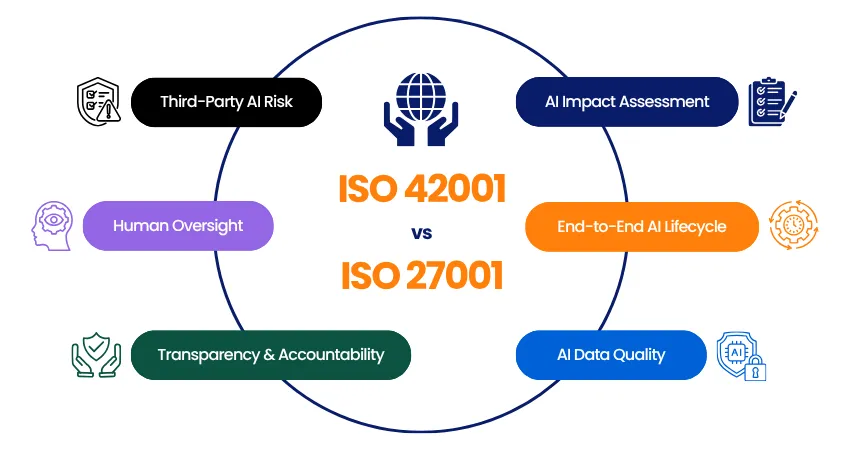
ISO 42001 covers areas ISO 27001 does not cover SaaS Companies. There are a number of different factors that have no corresponding mechanisms in an ISMS.
- AI system: You will need to assess the effects of your AI systems on individuals and groups, not solely on your organisation. There is no ISO 42001 equivalent for ISO 27001.
- AI life cycle: Annex A covers AI from the beginning to the end of its life cycle-from design and development through verification, deployment, and use, to eventual retirement. Security reviews are just one aspect of this; it's about suitability for purpose and designing responsibly.
- Data for AI tools: These controls help you assess data quality, origin, and preparation. If you run SaaS or customer-facing applications and train or fine-tune models on customer data, this is often where the difficult questions begin.
- Making your AI systems transparent and accessible: You must provide users and other interested parties with appropriate information about your AI systems, including how they can raise concerns.
- Responsible use and oversight: Set clear goals for responsible AI use, maintain human oversight, and understand where people remain in the loop.
- Third-party and customer relationships: Annex A covers AI-related risks from suppliers and other external parties, as well as customer responsibilities and information requirements.
All of the aforementioned factors do not replace security; rather, they serve a supportive role.
Questions AI-Driven SaaS Vendors Get That Other Vendors Do Not
Security and procurement teams are refining their approaches to evaluating software vendors and conducting due diligence. When vendors place significant demands on your team, these teams are adapting their due diligence accordingly. Vendors adopting AI should prepare for the following:
- Is AI central to your product? Is any of the technology outsourced?
- Is customer data leveraged for model training or improvements?
- How do you verify bias, and test for accuracy and harmful outputs?
- What human oversight exists, and how are errors escalated?
- How do you handle model updates and behavioural changes?
- Who in the organisation is responsible for AI risk, and to whom is it reported to management?
- Do you have an AI policy in line with a recognised framework?
An ISO 27001 certificate may help address questions two and four, although it may not address most of the remaining questions. An ISO 42001 certificate provides buyers with an independently audited response in an established format, helping to make security reviews more efficient and straightforward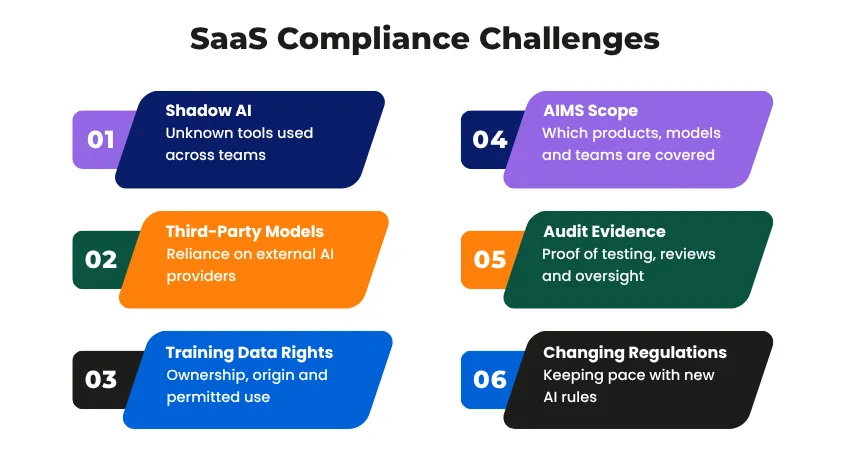
Key Areas Where SaaS Companies Face Compliance Challenges
These are the pain points we see across SaaS engagements:
Shadow AI and incomplete inventories. Your teams are deploying AI APIs and tools much faster than your governance team can see them. If you don't know about it, you can't govern it.
Third-party model dependency: If your product leverages an external model, you are relying on third parties over which you have little influence. You need to do due diligence on your supplier as well as the model provider.
Training data rights and provenance: Understanding where data comes from and whether you’re allowed to use it can sometimes be more challenging than you might expect.
Defining AIMS scope: Establishing boundaries for AIMS. It's not always obvious which product, model and teams should be included within the certification boundary.
Evidence that is more than policy. Auditors want to see impact assessments, testing, monitoring and review records, not just statements of intent.
Regulatory momentum. AI regulation (e.g., EU AI Act) is already underway. EU AI Act timelines are still evolving, so check with legal counsel for current deadlines. ISO 42001 certificates assist your governance position but do not alone indicate legal compliance.
How to Run One Program Across Both Frameworks
Running two separate programs doubles the workload. One integrated program reduces it across both frameworks and increases the workload. A single integration can always be useful in reducing the workload.
One framework: Apply a shared approach to policy, scope, risk methodology, document control, internal audits, and management reviews, adding AI-specific features where needed.
A unified view of risk with two filters: Expand your current risk process to include both security and AI risks, such as bias, model drift, and misuse.
Map controls once and show how they satisfy both standards: Map the controls once and demonstrate how they meet both standards where they overlap.
One audit cycle: Organisations often align ISO 42001 vs ISO 27001audits with the same certification body.
Assign governance to a single owner: Clearly define ownership and responsibilities, whether the role is assigned to the CISO, a GRC lead, or a cross-functional committee.
If you are beginning with information security, our ISO 27001 Certification Guide for Cloud & Tech Companies explains what "getting ready” entails for a cloud-based business. If your focus is currently on AI governance, our ISO 42001 Certification offers more details about the AIMS. Either way, INTERCERT can help bring these efforts together in a single program.
ISO 27001 First, ISO 42001 When SaaS Buyers Ask?
A logical order for SaaS startups:
Stage 1: Establish your security baseline with ISO 27001:2022 certification. ISO 27001:2013 certificates are no longer valid; certification to the 2022 version is required.
Stage 2: Engage in early, informal AI governance. Inventory your AI, identify owners, and develop an AI policy even while you are still selecting a certification.
Stage 3: Certification to ISO 42001 when needed. An enterprise RFP, an AI-specific security questionnaire and a regulated-sector customer are all huge indicators. As the ISMS already exists, the AIMS work is likely to be mainly about the AI-specific controls.
This phased approach means that you do not need to purchase a certification until market demand arises, while ensuring that you are prepared to meet that demand.
When a SaaS Business Needs ISO 27001, ISO 42001, or Both?
ISO 27001 should suffice if your product lacks meaningful AI and uses it only in minor internal tools.
When to use ISO 27001 and ISO 42001 together:
- Your product is built around AI-powered features. Buyers in enterprise, financial services, healthcare, and the public sector are asking about AI-specific due diligence.
- You train your own models, fine-tune them, or run customer data through AI.
- A unified set of narratives is needed for security and responsible AI.
- AI-native companies whose customers care primarily about AI governance and are developing their security programme in the lead-up to implementation.
The consistent factor is buyer expectations. Certification is always worthwhile when it removes barriers to a sale and maximizes trust among the buyers evaluating you.
Final Thoughts
ISO 42001 vs ISO 27001 work simultaneously, addressing the question SaaS buyers are more likely to ask. ISO 27001 helps show that your information security management system (ISMS) protects the data you handle. ISO 42001 helps demonstrate that your AI management system (AIMS) responsibly governs the AI you build, buy, and deploy-including accountability, risk assessments, data use, and thoughtful consideration of the people affected by your models.
Most SaaS providers may find it helpful to take a phased approach: start by establishing security with ISO 27001:2022, then build an AI inventory, clarify ownership, and put policies in place. You can pursue ISO 42001 certification when enterprise clients, RFPs, or buyers in regulated industries require it. Because both standards share the same management-system foundation, work undertaken for either can also support the other.
Not sure whether you need ISO 27001, ISO 42001, or both?
INTERCERT helps SaaS teams address these matters in a single conversation. We review your product, your use of AI, and your buyers’ requirements, then develop a unified certification roadmap tailored to your timeline.


 +1 (281) 720-3261
 info@intercert.com
 2001 Timberloch Place - Suite 500, The Woodlands, Texas 77380, United States