


What GCC Hospital CISOs Look for in an ISO 42001 Audit
Artificial intelligence (AI) is now integrated into various aspects of hospital operations, from prioritizing patients, receiving and interpreting ambulance calls, to scheduling patient appointments. As AI takes on a critical role across the sector, a board member may ask, “Are we properly governing the use of AI in the hospital?” It is an easy question to ask and a hard one to answer. Simultaneously, ISO/IEC 42001 certification is one credible way to provide this evidence.
To earn certification, a hospital must pass an audit. This guide explains what auditors will ask a hospital CISO in the Gulf, which parts of your AI management system they will assess, and what evidence you should have ready.
What an ISO 42001 Audit Covers
ISO/IEC 42001:2023 is the first certifiable AI management system (AIMS) standard. Still the current edition (AIMS) standard to be certified. The focus is not on validating a single model's accuracy but on evaluating how you manage artificial intelligence as an organization across every system you develop, acquire, or operate.
An auditor assesses two layers:
- The management system (clauses 4 to 10): scope, leadership, planning, support, operation, performance evaluation and improvement.
- Annex A includes 38 AI-specific controls across nine areas, including AI policy, organization, impact assessment, system lifecycle, AI data, and AI use. Add “Third-party and customer relationships (A.10)" to the list; it supports the vendor section. Select applicable controls and justify exclusions in a Statement of Applicability.
Certification bodies that audit AI management systems are expected to meet ISO/IEC 42006:2025, which adds AI-specific requirements to the general rules in ISO/IEC 17021-1. Before you choose one, ask for evidence that it is accredited for ISO/IEC 42001 by a recognised accreditation body. Accreditation is how an independent party confirms the certification body is competent and impartial.
Once the hospital's AIMS is found to conform to ISO/IEC 42001:2023, the certification body issues the certificate.
Auditors will first request an inventory of AI systems. This includes more than your clinical prediction model; it may also cover features in vendor software and other applications staff use for decision-making. Auditors interview clinicians to test whether the inventory is complete.

Why Hospitals Face Closer Scrutiny
Regulators treat health-related data as highly sensitive and impose stricter restrictions on its use. In the UAE, this is governed by Federal Law No. 2 of 2019 on the Use of ICT in Health Fields and Federal Decree-Law No. 45 of 2021 (PDPL). In Saudi Arabia, the Personal Data Protection Law (Royal Decree M/19 of 2021) classifies health data as sensitive personal data.
Since October 2025, Abu Dhabi licensed providers must follow the DoH Responsible AI Standard (DoH/ST/DDGO/RAI/V1/2025), which was scheduled for review in October 2026, so check for the latest version. Providers in Dubai are subject to the Dubai Health Authority (DHA) AI policy for the healthcare sector. Similarly, Saudi Arabia's SFDA regulates AI in the medical field. Accordingly, in addition to complying with the applicable regulations, hospital AI systems should be designed and implemented to meet requirements governing the residency of health data.
Even before hospital IT departments formally roll out AI systems, clinicians and administrators are already using AI assistants and applications to transcribe and summarize data. From an audit perspective, it is therefore fair to ask, "What AI applications are in use within the hospital?"
GCC Rules a CISO Maps to the Audit
ISO 42001 provides no legal protection and is not mandated by any GCC regulator. However, CISOs in the region use it to develop management-level policies and procedures, then interpret them in light of local legal requirements. To confirm the latest versions, consult your legal team.
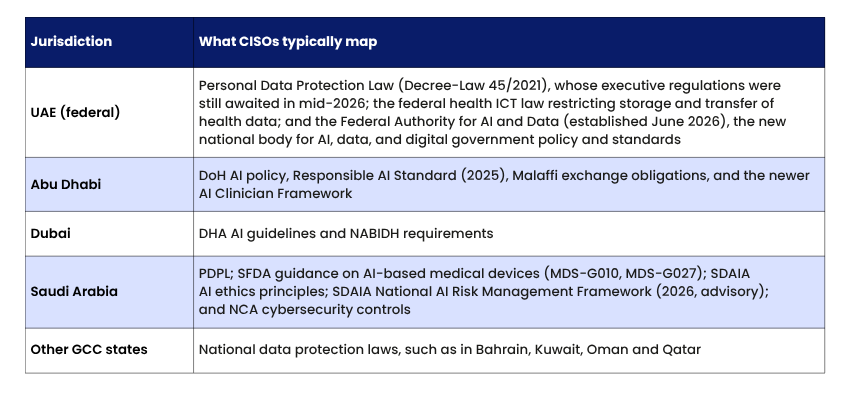
At the time of writing, neither Saudi Arabia nor the UAE has enacted a dedicated federal AI law. Hospital AI is nonetheless governed by related laws and frameworks, including the UAE and Saudi personal data protection laws (PDPLs), the UAE federal health ICT law, DoH and DHA policies, and SDAIA frameworks. The landscape is also changing quickly. In June 2026, the UAE established the Federal Authority for AI and Data, and Saudi Arabia's SDAIA has issued a draft Responsible AI Policy (2026) that would move the Kingdom from voluntary guidance toward supervision.
What Auditors Look For
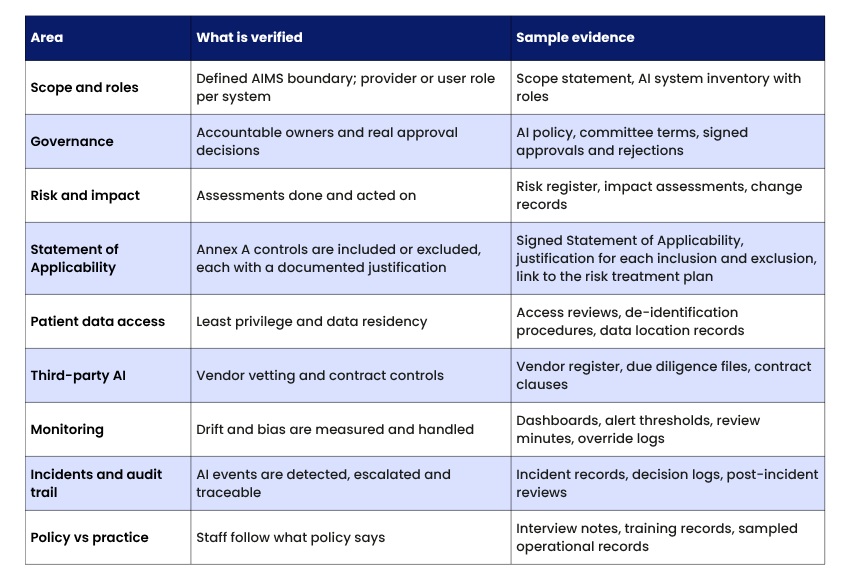
Auditors are most likely to focus on these eight areas of your organization.
1. Clear Scope and AI Roles (Provider vs. User)
AI providers and producers carry different controls from AI customers and users. Producers usually carry more on design, training data, and testing, while customers carry more on deployment, human oversight, input data, and monitoring. Auditors also expect the organization to understand its own role for each system: is it the AI customer/user, or the AI provider/producer? Most hospitals are AI customers/users of vendor systems, but they can become a provider or producer when they build, fine-tune, or substantially modify a system in-house. The controls required will vary with these roles.
To simplify, auditors will expect a plain-language scope statement that any board member can easily understand. They will also identify what data was used and the system’s role and inventory records. Insufficient information in this list would indicate deficiencies in the organization’s AI control framework.
2. Governance and Decision Rights
Expect to identify the individual or individuals authorized to approve an AI system’s use and remove it from service. Auditors will also want to see minutes documenting the AI governance committee’s approval and retirement decisions, including the rationale and justification for each.
3. Assessments of Risk and Impact of AI Systems
As in ISO 27001, assess risk (6.1.2); ISO 42001 adds AI system impact assessment on individuals, groups and society, e.g., patients (6.1.4). Auditors will look for evidence that AI system users have taken into account aspects of bias and failure modes and adjusted their practices accordingly.
Take the example of a sepsis alert model. Meaningful assessment of impact includes analysing performance across different ages and languages, as well as for patients with incomplete records. What does the model do, and how does it operate to generate alerts? What happens if the model fails to generate an alert for a particular patient? Finally, how are the model's limitations communicated to clinicians?"
4. Patient Data Access Control
Auditors verify which roles can access patient data to train, tune, or validate each model, based on their assigned roles. Additional audits can also confirm that data is used only for approved purposes and remains in approved hosting locations. As ‘large’ generative models become more common, users may be tempted to enter patient data into ‘chat’ applications. What auditors check: an approved GenAI tool list, DLP/blocking for public chatbots, and staff guidance?
Auditors check the provenance and lawful basis of data used to train or tune models (A.7.5)." Not limited to generative models. Was the data processed inside the country, and does this meet data residency rules?
5. Third Party and AI Vendor Models
In reality, Most hospital AI comes from vendors, so auditors focus on supplier controls (A.10). How does the hospital carry out vendor due diligence and require advance notice of AI model changes? Maintaining a register of third-party AI models, including the vendor name and the date of the last review, would be one good practice.
Before the vendor implements any update to the AI model, ask them to assess the risk posed by the change in a comparable manner.
6. Model Monitoring, Bias and Drift
Once a clinical decision support system has been implemented, auditors expect that you will monitor for bias and drift against the defined performance metrics and take action on any alerts generated. They will also ask how clinicians can override the system's output and how overrides are logged.
"Accuracy of the model is monitored" is not evidence of anything. "We will review the model's sensitivity monthly" and "If monthly sensitivity falls below 90%, a member of the team will investigate" are measurable criteria. Evidence is the dated review records showing that each review took place and what was done in response.
7. Incident Investigation and Audit Logs
What steps are taken when an AI system provides advice that is unsupported, inappropriate, or unethical? How are AI-related patient data breaches investigated? Auditors will check whether the system’s logs allow them to reconstruct its actions and decisions.
Prior to the audit, run a tabletop exercise simulating unsafe AI advice and keep the minutes.
8. Policy vs Practice
More often than not, auditors' questions focus on this theme. They compare your organization’s AI policies with the logs and tools used to implement them and speak with engineers and clinicians. A common finding is that polished AI policies don't align with day-to-day practice.
Before the audit, train relevant staff on the process for reporting concerns about the particular AI system (A.3.3).

How ISO 42001 Builds on ISO 27001
Both standards follow the ISO Harmonized Structure (clauses 4-10), so core management system requirements such as document control, internal audit, and management review are essentially the same in both. Access control and incident response are not shared clauses: they are controls in ISO 27001 Annex A. Consequently, an ISO 42001 audit will also cover many of the management system elements of an ISO 27001 audit.
If you already hold ISO/IEC 27001 certification, ask us about an integrated audit. Please contact us to learn more about combining these audits. ISO 27001 does not cover AI-specific elements such as impact assessment, lifecycle and data provenance.
Audit Stages: Stage 1, Stage 2, Surveillance
Stage 1 reviews AI management system documents to assess whether business AI risks and impacts are addressed and confirms readiness for Stage 2 (scope, SoA, internal audit, and management review completed).
Stage 2 of the audit verifies AIMS implementation and effectiveness through interviews, observation and record sampling.
After both steps are completed, the certification decision is made by competent person(s) not involved in the audit.
Certification is valid for three years. During this period, an annual surveillance audit verifies continued conformance with the standard. At the end of the three-year period, a full recertification audit is conducted.
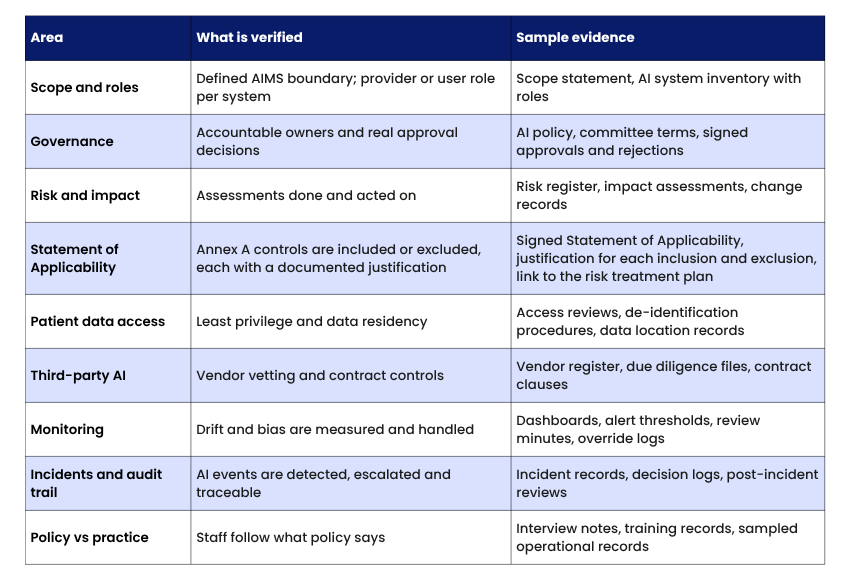
Evidence Table: What Is Verified and What Proves It
How to Prepare Before Stage 1
The steps you take several months before the audit can make the biggest difference to your audit readiness:
- Complete impact assessments for your highest-risk clinical systems.
- Conduct both an internal audit and a management review.
- Map Annex A controls to local requirements and record inclusions/exclusions with justification in your SoA.
- Run a simulated AI incident (tabletop) and record the outcome involving the AI system.
- Confirm the certification body is accredited for ISO/IEC 42001 against ISO/IEC 42006:2025. Audits cover the AIMS, not an AI system.

Audit-Readiness Checklist for GCC Hospitals
When hospital CISOs prepare for their ISO 42001 audit, the conversation will likely shift from "Do you have an AI policy?" to "Can you show me how this AI system is approved, monitored, and managed?" Effective readiness is more practical. It includes:
- Maintain an exhaustive inventory of AI, including AI within vendor solutions.
- Perform documented risk and impact assessments for each clinical and data-sensitive system.
- Show evidence of human oversight, logs, and training records.
- Conduct security tests of AI and its surrounding environment.
- Maintain dated evidence with owners named.
Teams that compile this evidence in advance spend audit time verifying their work rather than searching for evidence.
Talk to an INTERCERT Expert about ISO/IEC 42001 certification for your hospital


 +1 (281) 720-3261
 info@intercert.com
 2001 Timberloch Place - Suite 500, The Woodlands, Texas 77380, United States