


ISO 27001 Implementation Timeline for Indian SaaS Startups
Large organizations evaluate security practices before partnering with technology providers. Security questionnaires, vendor assessments, and contractual requirements often require SaaS companies to demonstrate that they have structured processes for protecting sensitive information.
This is where ISO 27001 for SaaS Startups India becomes increasingly valuable. The standard provides a globally recognized framework for establishing an Information Security Management System (ISMS) that helps organizations identify risks, implement security controls, and continuously improve their information security practices.
One of the most common questions startup founders ask is: How long does ISO 27001 certification take? The answer depends on several factors, including the startup’s existing security maturity, organizational size, technology environment, and readiness.
This guide explains the ISO 27001 Implementation Timeline, key integration phases, certification steps, and practical considerations for Indian SaaS startups preparing for certification.
What Is the ISO 27001 Implementation Timeline?
The ISO 27001 Implementation Timeline refers to the period required for an organization to establish an Information Security Management System, implement necessary controls, prepare documentation, complete internal reviews, and successfully undergo the certification audit.
There is no universal timeline because every startup begins from a different level of security maturity. For many startups, the ISO 27001 Certification Timeline can range from several months to longer depending on preparation and implementation requirements.
The timeline is generally influenced by:
- Organization size and complexity.
- Number of employees and teams involved.
- Existing security practices.
- Cloud infrastructure complexity.
- Number of applications and systems in scope.
- Availability of internal resources.
- Existing compliance frameworks.
- Management commitment.
How Long Does ISO 27001 Certification Take?
A common question among founders is: How Long Does ISO 27001 Certification Take?
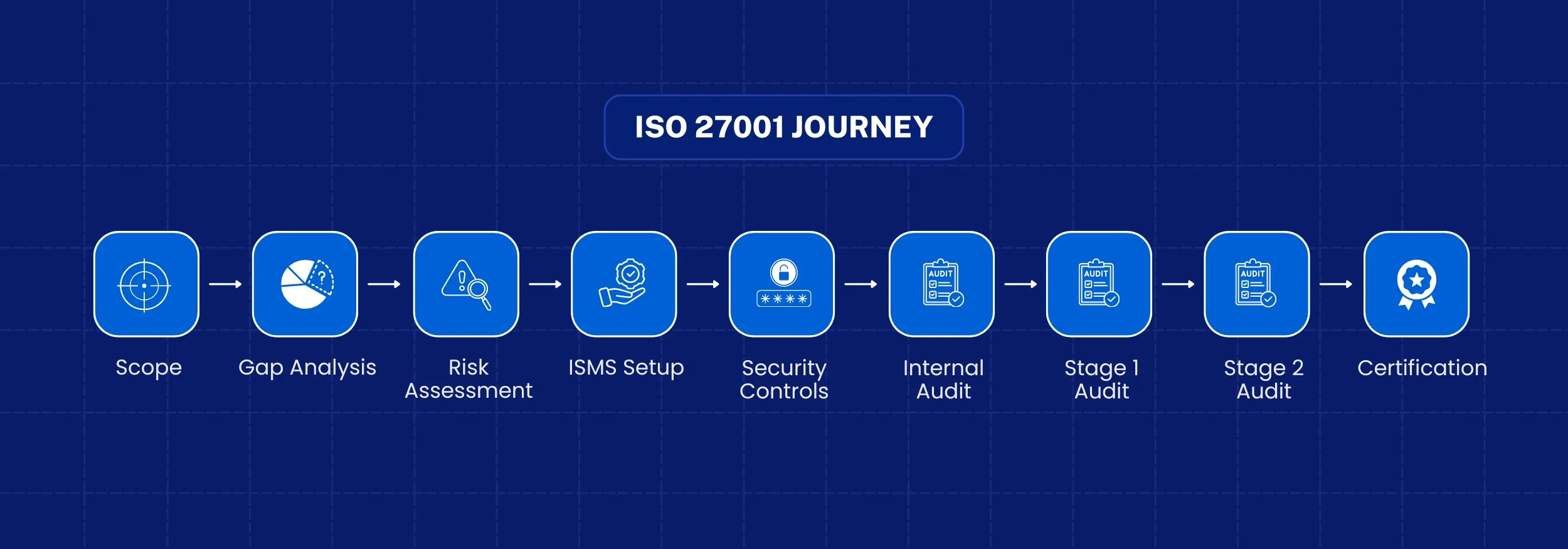
While timelines vary, a typical SaaS startup may follow a structured approach consisting of several phases:
Smaller startups with mature security practices:
- May complete implementation within a shorter timeframe.
- Often have existing cloud security controls and documentation.
Growing startups developing their security program:
- May require additional time to establish policies, processes, and evidence.
- Usually spend more time improving operational maturity.
Organizations with complex environments:
-
May require longer implementation periods due to multiple applications, locations, teams, or regulatory requirements.
Achieve internationally recognized ISO/IEC 27001 Certification with INTERCERT and demonstrate your commitment to information security and compliance.
ISO 27001 Implementation Steps for SaaS Startups
A successful certification journey follows structured ISO 27001 Implementation Steps designed to build an effective ISMS.
Step 1: Define ISMS Scope
The first step in the ISO 27001 implementation journey is defining the boundaries of the Information Security Management System (ISMS). Startups need to identify the products and services covered, applications and infrastructure included, business processes involved, locations and teams within scope, and critical information assets requiring protection. A clearly defined ISMS scope helps prevent unnecessary complexity and allows startups to focus their resources on protecting the information that is most important to their business operations.
Step 2: Conduct a Gap Assessment
Before implementing security controls, organizations need to evaluate their existing security practices against ISO 27001 requirements. A gap assessment helps identify areas that require improvement, including missing policies and procedures, security control weaknesses, documentation gaps, process inefficiencies, and additional resources required for compliance. For many startups, this assessment provides the foundation for developing a practical ISMS Implementation Roadmap and establishing priorities for the certification journey.
Step 3: Perform Information Security Risk Assessment
Risk assessment is one of the core principles of ISO 27001 and helps organizations understand their security priorities. During this stage, startups identify critical information assets, potential security threats, existing vulnerabilities, possible business impacts of security incidents, and appropriate risk treatment options. This process enables organizations to determine which security controls are necessary based on their specific environment and risk profile. For an Information Security Management System Startup, this risk-based approach ensures that security investments are directed toward the areas with the highest business impact.
How to Build an Effective ISMS?
An effective ISMS Implementation Roadmap provides startups with a structured approach to achieving ISO 27001 certification while minimizing disruption to daily business operations.
Phase 1: Planning and Preparation
The first phase focuses on establishing the foundation for implementation. Startups define project objectives, assign security responsibilities, establish timelines, understand ISO 27001 requirements, and identify key stakeholders. Leadership involvement is essential at this stage, as ISO 27001 requires organization-wide commitment rather than being limited to the IT team.
Phase 2: Developing the ISMS Framework
During this phase, startups establish the management system required by ISO 27001. This includes developing information security policies, defining risk management processes, assigning security roles, implementing applicable controls, and creating monitoring and review mechanisms. Organizations must also meet ISO 27001 Documentation Requirements by maintaining relevant policies, procedures, records, and evidence demonstrating that the ISMS is effectively implemented.
Phase 3: Executing Security Controls
The next stage focuses on operationalizing security practices across the organization. Startups implement controls related to access management, asset management, incident response, supplier security, business continuity, security awareness training, logging and monitoring, and vulnerability management. For SaaS startups, these controls often integrate with existing cloud environments, DevOps workflows, and software development practices.
Completing the ISO 27001 Certification Process for Startups
After implementing the necessary security controls and establishing the Information Security Management System, startups move toward evaluating whether the ISMS is ready for certification.
The ISO 27001 Certification Process for Startups generally includes internal evaluations, management reviews, corrective actions, and an independent certification audit. This preparation stage is important because certification auditors evaluate not only whether documentation exists but also whether security practices are consistently followed across the organization.
Before approaching a certification body, organizations should ensure that:
- ISMS policies and procedures are implemented.
- Security controls are operating effectively.
- Risk assessments are completed.
- Employees understand their security responsibilities.
- Required evidence and records are maintained.
- Internal audits have been conducted.
ISO 27001 Stage 1 Stage 2 Audit Explained
The ISO 27001 Stage 1 Stage 2 Audit is conducted to evaluate whether an organization’s Information Security Management System meets the requirements of the standard.
Stage 1 Audit: Documentation and Readiness Review
The Stage 1 audit focuses on reviewing the organization’s readiness for certification. Auditors evaluate key elements such as the ISMS scope, information security policies, risk assessment methodology, Risk Treatment Plan, Statement of Applicability (SoA), documented procedures, and overall organizational preparedness. The objective is to confirm that the necessary foundation is established before proceeding to the Stage 2 audit. Any identified gaps may need to be addressed before certification assessment continues.
Stage 2 Audit: Implementation and Effectiveness Review
The Stage 2 audit evaluates whether the ISMS has been effectively implemented and is operating as intended. Auditors review evidence related to security processes, operational controls, employee awareness, risk management activities, incident management, access controls, monitoring practices, and continual improvement initiatives. If the organization demonstrates conformity with ISO 27001 requirements, certification can be issued by an accredited certification body. For SaaS startups in India, selecting the right ISO 27001 Certification Body India is important to ensure an impartial and independent assessment of the ISMS.
ISO 27001 Certification Checklist for SaaS Startups
A structured ISO 27001 Certification Checklist helps startups track readiness before the certification audit.
Key checklist areas include:
ISMS Planning
- Defined ISMS scope.
- Assigned information security responsibilities.
- Established security objectives.
Risk Management
- Completed information security risk assessment.
- Identified critical assets.
- Created risk treatment plans.
- Prepared Statement of Applicability.
Documentation
- Information security policies established.
- Required procedures documented.
- Security records maintained.
- Evidence collection processes implemented.
Security Controls
- Access management implemented.
- Asset inventory maintained.
- Backup processes defined.
- Incident response procedures established.
- Supplier security controls reviewed.
- Security monitoring implemented.
Audit Preparation
- Internal audit completed.
- Management review conducted.
- Corrective actions addressed.
Take the next step toward ISO/IEC 27001 Certification and strengthen your organization's security posture with INTERCERT.
Understanding ISO 27001 Documentation Requirements
Documentation plays an important role in demonstrating that the ISMS is structured and repeatable. However, ISO 27001 is not about creating unnecessary paperwork. The focus is on maintaining relevant documentation that supports effective security management.
Typical ISO 27001 Documentation Requirements may include:
- Information security policy.
- ISMS scope document.
- Risk assessment methodology.
- Risk assessment results.
- Risk Treatment Plan.
- Statement of Applicability.
- Security procedures.
- Internal audit records.
- Management review records.
- Incident management records.
- Training and awareness records.
ISO 27001 Certification Cost for Startups
Another important consideration for growing companies is the ISO 27001 Certification Cost for Startups.
The overall investment depends on several factors, including:
- Startup size.
- Number of employees.
- Complexity of systems and applications.
- Existing security maturity.
- Scope of certification.
- Internal resources available.
- Technology environment.
- Certification audit fees.
- Ongoing surveillance audits.
Startups should understand that implementation costs and certification costs are separate. Building an ISMS may require investment in security tools, process improvements, employee training, and documentation activities, while certification involves independent assessment fees.
Organizations should view ISO 27001 as a business investment that supports customer trust, improves security governance, and enables enterprise growth.
Can Startups Achieve Fast Track ISO 27001 Certification?
Many organizations search for Fast Track ISO 27001 Certification options, especially when enterprise customers require security assurance quickly.
However, certification should not be viewed as simply completing paperwork within a short period. A credible ISO 27001 certification requires evidence that the ISMS is properly established and operating effectively.
Startups can improve efficiency by:
- Defining a realistic scope.
- Prioritizing critical security controls.
- Maintaining proper documentation from the beginning.
- Assigning internal ownership.
- Using existing security practices where applicable.
- Preparing evidence continuously.
Best Practices for Indian SaaS Startups Implementing ISO 27001
For ISO 27001 for Early Stage Startups, starting with strong security foundations early can reduce future compliance challenges as the company grows.
Organizations pursuing ISO 27001 for SaaS Startups India should consider the following practices:
- Obtain leadership commitment early.
- Build security into daily operations.
- Maintain accurate asset inventories.
- Conduct regular risk assessments.
- Establish clear security ownership.
- Train employees regularly.
- Monitor security performance.
- Review suppliers and third-party risks.
- Conduct internal audits before certification.
- Treat ISO 27001 as an ongoing security improvement program.
Secure Growth Starts with ISO 27001
A well-planned ISO 27001 Implementation Timeline helps startups move from informal security practices toward a mature Information Security Management System. By following defined implementation steps, completing risk assessments, preparing documentation, and approaching certification systematically, startups can strengthen security while building customer confidence.
As an accredited ISO 27001 Certification Body India, INTERCERT provides independent third-party certification services for organizations seeking conformity with internationally recognized information security management system standards. Through impartial certification assessments, organizations can demonstrate their commitment to information security, governance, and continual improvement to customers, partners, and stakeholders.


 +1 (281) 720-3261
 info@intercert.com
 2001 Timberloch Place - Suite 500, The Woodlands, Texas 77380, United States