


HITRUST vs ISO 27001: Which Security Framework Fits Your Business?
HITRUST and ISO 27001 are excellent frameworks for businesses and organizations. To better understand the feasibility, let's consider an example: you have received two messages in your inbox. One is from a U.S. hospital group inquiring whether you hold a HITRUST certificate. The other is from a European enterprise buyer requesting your ISO 27001 certificate. Both inquiries are important and come from prospective customers. However, you have the budget and time to pursue only one certification this year.
So which one comes first?
This post provides a clear comparison of HITRUST vs ISO 27001, helping you determine which framework to choose based on your buyers, region, and available budget. It also offers a concise overview for non-U.S. vendors whose U.S. healthcare customers require HITRUST certification.
The short answer
- Choose ISO 27001 if you operate globally, serve buyers in Europe, the Middle East, or Africa, and seek a management system for your overall security program.
- Choose HITRUST if your customers are U.S. healthcare providers or payers or if you handle a large amount of sensitive health data.
- Choose both if you operate in both the U.S and non-U.S healthcare systems. ISO 27001 can serve as a strong foundation for your management system.
What Is HITRUST CSF?
HITRUST CSF, created by the HITRUST Alliance, is a security and privacy framework that the Alliance says covers over 70 regulations, standards, and frameworks (HITRUST CSF v11.8/v11.9). It aims to ease compliance with diverse requirements. Originating in healthcare, it is most familiar to and commonly requested by US hospitals, health plans, and their business associates, though it is also used in other industries.
HITRUST offers three core validated assessments.
- HITRUST e1 (Essentials, 1-year): A 1-year baseline of about 44 requirement statements for lower-risk environments.
- HITRUST i1 (Implemented, 1-year): A moderate-assurance, 1-year assessment of about 182 requirement statements.
- HITRUST r2 (Risk-based, 2-year): A risk-based, 2-year assessment of 182 i1 baseline statements plus risk-based tailored statements; highest assurance.
HITRUST offers flexibility, allowing you to select the assessment that best meets your customer’s needs and requirements. For a clearer understanding of what the controls require, please refer to our guide to HITRUST controls.
What Is ISO 27001?
ISO 27001 guides you through building an Information Security Management System (ISMS). It outlines management guidance on how to identify risks, select controls, and implement, monitor, review, and improve them.
The Current edition, ISO/IEC 27001:2022/Amd 1:2024 (climate action changes to clauses 4.1 and 4.2), contains mandatory clauses 4-10 and Annex A (93 controls). Part one includes the mandatory clauses of a management system (4 to 10). On the other hand, Part two consists of Annex A, a list of 93 controls, grouped into four categories: organizational, people, physical and technology. Using your judgment, identify the applicable Annex A controls and record them in a Statement of Applicability.
An accredited certification body will conduct an audit. If it determines that your organization meets the applicable requirements, it will issue a certificate. If you want the full picture, read about the need for ISO 27001 for businesses that handle customer data.
HITRUST vs ISO 27001: Quick Comparison
Here’s the full comparison, followed by a detailed explanation of each part.
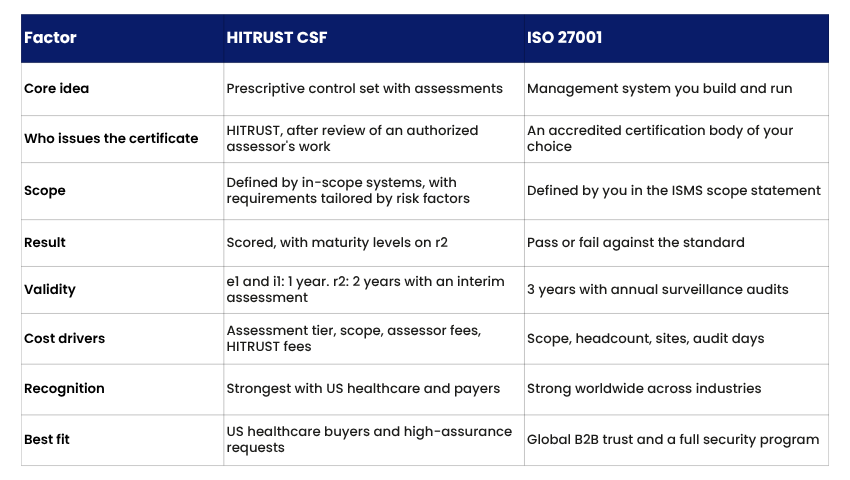
Difference 1: An Ongoing Management System or a Prescriptive Control Set?
The key difference is their approach: ISO 27001 is a management system standard, while HITRUST is a prescriptive control framework.
For ISO 27001, you assess risks, choose controls to address them, assign owners, conduct internal audits, and review the results with leadership. The standard describes what an effective system looks like; you decide which controls apply and how robust they should be.
In HITRUST, the framework specifies what to implement. The requirements are clear, and your assessment tier determines how many you need to meet. This reduces guesswork and makes it easier to compare results across companies. It also leaves less room to explain why a particular control doesn’t apply to your company.
A straightforward way to remember the distinction is that ISO 27001 asks, “Have you built a system that manages security risk?” while HITRUST asks, “Have you implemented these specific controls, and for r2, how mature are they?”
Difference 2: A Single Issuing Body or Multiple Certification Bodies?
HITRUST has a single issuing body. An approved assessor firm tests your controls, and an Authorized HITRUST External Assessor submits the assessment through HITRUST MyCSF. HITRUST conducts a centralized quality-assurance review, and if the controls are implemented adequately, HITRUST issues the certification. This centralized review is a key selling point of the framework; every assessment is evaluated the same way.
With ISO 27001, many certification bodies can audit your organization. Each is accredited by a national accreditation body under rules such as SO/IEC 17021-1:2015 and ISO/IEC 27006-1:2024. Since there is no central review of all audits, the quality of the certification depends on the quality and independence of the certification body you opt for.
That is why selection of the certification body is important. Look for these when selecting a certification body.Below, we have mentioned a few points for better reference:-
- Current accreditation for ISO 27001 from a recognized accreditation body.
- Auditors with experience in information security in your industry.
- The body that audits you should not have helped build your system.
- A verifiable certificate that your customers can check. Example: verifiable via the accreditation body or IAF CertSearch.
Difference 3: What’s Included in Your Scope
Both allow you to narrow your scope, but differently.
For ISO 27001, the scope is defined by boundaries and applicability. Clauses 4-10 cannot be excluded; only Annex A controls via SoA. This can help to certify a single product, a business unit, or the entire organization. Auditors assess whether the scope is logical and reasonable.
Under HITRUST, the assessment scope is defined by the systems, facilities, and data included in the assessment. For HITRUST r2, organizational, system, and regulatory factors determine the applicable requirements based on the assessment scope and environment. Broader and more complex scopes may increase the number of applicable requirements.
HITRUST e1 and i1 follow fixed assessment baselines. Both allow third-party carve-outs, whereas r2 does not.
Practical tip: Choose an assessment based on your organization's security needs, customer expectations, and assessment scope.
Difference 4: Pass/Fail Result or Maturity Scoring?
Under ISO 27001, an audit is conducted to determine whether an organization conforms to the standard. Identified nonconformities must be remediated. Major nonconformities must be corrected before certification; minor ones need a corrective action plan accepted by the certification body and must be checked and corrected before certification. Certification results in the issuance of a certificate, not a score.
HITRUST uses different scoring approaches for its assessment types. HITRUST r2 applies five maturity levels: Policy, Procedure, Implemented, Measured, and Managed. HITRUST e1 and i1 assess the Implemented level only. For r2, all requirement statements are scored across Policy, Procedure, and Implemented levels, while Measured and Managed scoring is optional.
Why this matters to you:
- ISO 27001 ISO 27001 is simpler to understand: you either conform or you don't.
- HITRUST r2 gives clients greater transparency into control maturity.
- HITRUST e1 and i1 score implementation only, giving a standardized, comparable result.
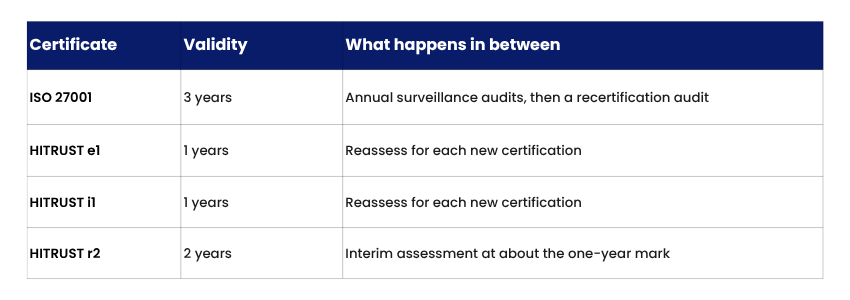
Difference 5: How Long Your Certificate Stays Valid
The validity models differ, as does the effort required between audits. As per Assessment Handbook v1.2 (enforced from 15 Apr 2026), an e1 or i1 can be used instead of the r2 interim assessment. r2 can also be extended by 90 days via a bridge assessment. Below, I have attached a table for better understanding:-
Difference 6: What Drives the Total Cost
Cost is a key consideration for most readers, and the honest answer is that it depends on the scope. We are unable to provide a figure, as any estimate given without a clearly defined scope could be misleading. The factors that influence the cost are listed below.
HITRUST cost drivers
- HITRUST tiers—e1, i1, and r2—increase in requirements and testing depth.
- The size and complexity of your scope systems and facilities, data and users
- The external assessor’s fees
- HITRUST fees for the MyCSF platform and quality assurance review
- Gaps in controls remediated prior to validation
- Annual recertification (e1/i1) or interim assessment (r2)
ISO 27001 cost drivers
- The number of employees and sites determines the number of audit days.
- The complexity of the scope and maturity of the controls.
- Certification body fees for Stage 1 and 2, the recertification audit every 3 years.
- Time and cost for the risk assessment, documentation, internal audits and management reviews.
- Tooling, training, and external help.
Compared with ISO 27001, HITRUST r2 typically entails higher costs for the same organization. The most cost-effective certification is the one your customers will accept. Choosing ISO 27001 over HITRUST r2 for a customer contract that requires HITRUST r2 does not reduce costs; it delays the deal.
Difference 7: Where Each Certificate Gets Recognized
Recognition depends on your buyers, so this often decides HITRUST vs ISO 27001.
ISO 27001 is recognised globally. It is included in RFPs and vendor lists across Europe, the Middle East, Africa and Asia, across various industries. It helps comply with local rules such as the NIS2 Directive, Gulf Cooperation Council (GCC) cybersecurity frameworks and South Africa’s POPIA. It doesn’t replace them, so check directly with each regulator or buyer for requirements.
HITRUST is prevalent among US health plans, hospitals, and their vendors (business associates). Many large US buyers include HITRUST in contracts and frequently use HITRUST assessment results to support their vendor risk management processes. Outside the US, it is not typically requested. However, clients that sell into the U.S. may require it.
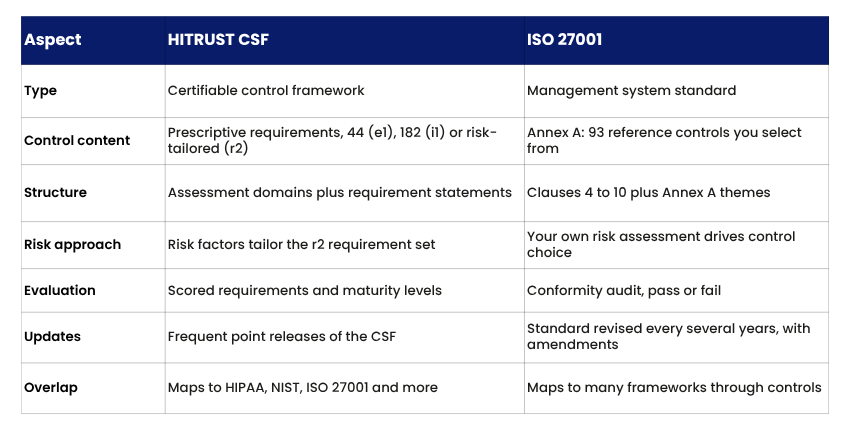
Framework Comparison: HITRUST vs ISO 27001
Now let's understand the difference between HITRUST CSF and ISO 27001
The Core Building Blocks of HITRUST
HITRUST has six main parts:
Control requirements: Requirement statements: Grouped into assessment domains such as third-party assurance, vulnerability management, and data protection and privacy.
Assessment tiers: e1, i1 and r2, each with a different depth and period of validity.
Maturity scoring: For r2, requirements are scored under policy, procedure, implemented, measured and managed.
Inheritance: Controls can be inherited from providers like cloud, resulting in a reduction of your testing workload when the assurance of those providers is in place.
External assessor and quality review: Controls are validated through the use of an authorized assessor and subsequent HITRUST review prior to certification.
Corrective Action Plans (CAPs): Gaps become documented action plans with owners and target dates.
You can understand this better by following our Guide to HITRUST Certification.
The Core Building Blocks of ISO 27001
There are six main parts to ISO 27001:
Context and scope: Understand the organization and the interested parties and define the scope.
Leadership: Top management establishes the intent and provides direction.
Risk assessment and treatment: Identify risks and decide how to treat the risks and report the findings.
Statement of Applicability: Document which of the 93 controls in Annex A apply and tthe justification for inclusion or exclusion.
Operation and monitoring: Implement and operate the controls and measure and monitor performance.
Improvement (Clause 10): Identify nonconformities, take corrective action and continually improve the ISMS.
The Annex A controls cover four areas: organizational (37 controls), people (8), physical (14) and technological (34). If your old documentation still uses the 2013 structure with 114 controls, the transition deadline has passed. All ISO 27001:2013 certificates expired or were withdrawn by 31 Oct 2025. See key changes between ISO 27001:2013 and ISO 27001:2022 for help.
HITRUST vs ISO 27001: How to Choose the Right One
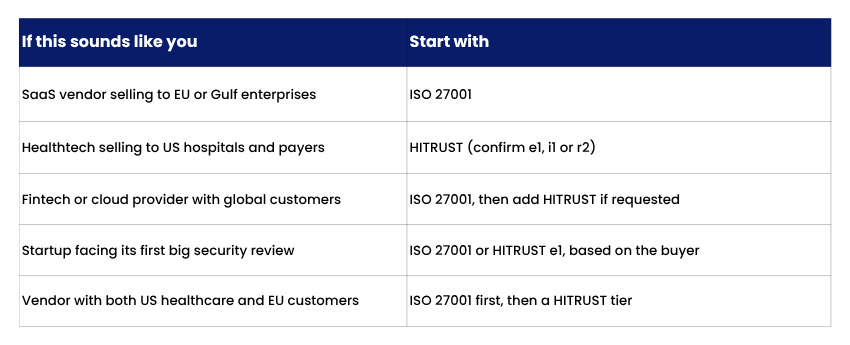
HITRUST or ISO 27001: Neither framework wins every time; the right choice depends on your situation. To better understand, read the questions listed below:
Is there a contract that requires HITRUST or ISO 27001? If the contract specifies “HITRUST r2” or an “ISO 27001 certificate,” that resolves it. Confirm the exact tier (e1, i1, or r2) before starting work.
Where are the buyers? If most of your buyers are in Europe, the Middle East, and Africa (EMEA), lean toward ISO 27001. If they’re primarily in U.S. healthcare, lean toward HITRUST.
How sensitive is the data? If the data consists of large volumes of protected health information (PHI), lean toward HITRUST i1 or r2.
What do you want to build? Choose ISO 27001 to integrate organizational security into a management system; choose HITRUST for a defined, scored checklist.
What can you spend and staff? If the budget is limited and no contract requires r2, consider HITRUST e1/i1 or ISO 27001.
A Short Angle for Non-US Vendors Asked for HITRUST
If you are based in the EU, Middle East or Africa and a U.S. healthcare customer requests HITRUST, follow these steps:-
- Understand the tier they need: Many customers accept e1 or i1, but some require r2.
- Find out when they need it: Determine if they require a certificate prior to contract signing, or if they will accept a plan with target dates.
- Check how you handle U.S. patient data: HITRUST scope can be limited to systems that process US patient data.
- Use ISO 27001 as a base: The two will overlap significantly, and a functioning ISMS will help. However, you’ll need HITRUST for the requirements and validation.
- HIPAA mapping: HITRUST can issue a HIPAA Insights Report when HIPAA is added as a compliance factor. See how your controls align with our HIPAA–ISO 27001 mapping.
Authorized HITRUST External Assessors operate outside the United States, so geographic location should not be a barrier. Ensure that evidence and scope are planned diligently.
Get ISO 27001 Certified Faster with INTERCERT's Independent Audits
HITRUST and ISO 27001 address the same core trust issue, but in different ways. HITRUST provides a scored, standardized answer for the US healthcare buyer. By contrast, ISO 27001 offers an internationally recognized, more flexible solution and a management system that enables organizations to integrate security throughout their operations.
If your customers are mainly in Europe, the Middle East, Africa, and other global markets, ISO 27001 is typically the fastest way to demonstrate credibility, while providing a foundation you can later extend to HITRUST.
As an independent certification body, INTERCERT audits your ISMS against ISO/IEC 27001:2022 and issues an accredited certificate your customers can verify.
Ready to get started? Learn more about ISO 27001 certification services or contact us to define the scope of your audit and get a tailored plan.


 +1 (281) 720-3261
 info@intercert.com
 2001 Timberloch Place - Suite 500, The Woodlands, Texas 77380, United States