


HITRUST 2026 Trust Report: Risks, Trends and CSF v11.9.0
Nearly one-third of the security incidents organizations report are attributed to suppliers. Yet a supplier may be considered ‘secure’ simply because of how it answered a HITRUST questionnaire. The 2026 HITRUST Trust Report, published on April 7, 2026, addresses this problem in a segment it calls the “Trust Crisis.”
In this guide, we'll delve into more detail on the report's findings, the reasons why vendor risk and AI are the most prominent themes, the role HITRUST CSF v11.9 plays in addressing these topics, and what your team should do going forward. Our other resources on compliance and risk that overlap with HITRUST include our HIPAA compliance guide and a SOC 2 overview.
Key findings from the report:
- In 2025, 99.62% of HITRUST CSF-certified environments avoided breaches, while independent surveys (KPMG) found that over 40% of organizations had experienced one.
- The share of breaches involving a third party doubled, from approximately 15% to approximately 30% (Verizon 2025 DBIR)
- AI threats are now tracked explicitly. CSF v11.8.0 added OWASP Top 10 for LLMs coverage, and CSF v11.9 adds coverage for agentic AI.
- The report argues that standardized, independently reviewed assurance beats questionnaires and self-attestation.
HITRUST Trust Report: 2026 Landscape at a Glance
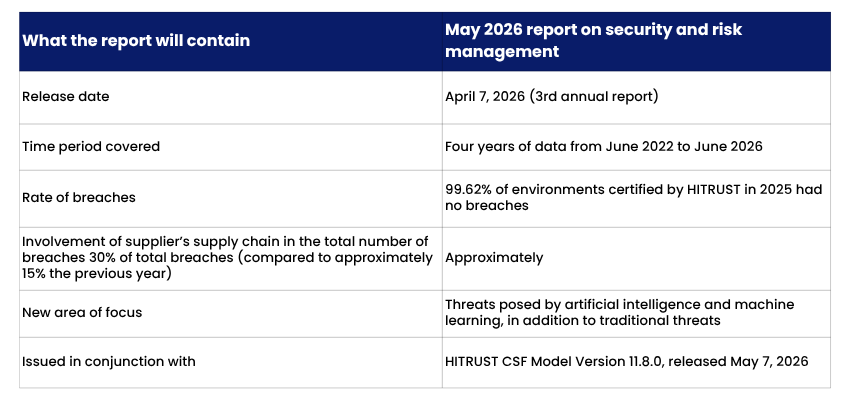
Now in its third edition, the 2026 Trust Report draws on four years of data from HITRUST-certified environments. Its most notable finding is that 99.62 percent of these environments were not affected by a security breach in 2025. HITRUST compares this figure with independent surveys showing that more than 40 percent of organizations have experienced a breach.
As the report’s theme, the Trust Crisis describes a widening Trust Gap between what assurance boards, regulators, cyber insurers and investors demand of third-party security and third parties' ability to provide it. Programs still rely on questionnaires, surveys and inconsistent reporting.
The following is a summary of the report:
A Widening Trust Crisis Under HITRUST Trust Report
The “Trust Gap” vendors answer arises from the nature of the tools security teams use to evaluate vendors. Questionnaires are often not standardized and may be written by vendors to promote and embellish their offerings. Consequently, comparing vendors’ responses to the same question can be extremely difficult.
The report identifies three main reasons for the trust gap:
- Self-attestation: No external party verifies the controls that are in place.
- Framework flexibility: The principles in various frameworks let organizations define their own controls, which leads to variance. For this reason, HITRUST QA reviews 100% of submitted validated assessments, while readiness assessments are not reviewed (Handbook 4.1).
- Third-party report variability: Relying on third-party reports to validate controls works only if the reports are accurate and up to date.
HITRUST recommends documenting and mapping threats to controls, followed by an independent quality review. As the infographic notes, CPAs have concerns about SOC quality and objectivity. HITRUST has also acknowledged concerns expressed by CPA firms regarding SOC 2 reports. Until your customers stop requesting SOC 2 reports, you may need both reports. To help determine which report to provide to your customers, see “SOC 2 Report vs. HITRUST Report.”
According to the Verizon 2025 Data Breach Investigations Report (DBIR), nearly one-third of breaches involve a third party. Yet a supplier may be considered “secure” simply because of how it answered a HITRUST questionnaire. The 2026 HITRUST Trust Report, published on April 7, 2026, addresses this problem in a segment it calls the “Trust Crisis.”
Vendor and Supply Chain Exposure
Threats posed by third parties in the supply chain are of significant concern to many organizations. The Verizon 2025 DBIR found that the share of breaches involving a third party doubled in a year, from approximately 15% to approximately 30%.
Implementing supply chain assurance is complex for at least three reasons.
- First, supply chains often include hundreds or thousands of vendors of varying effectiveness and security levels.
- Second, vendor-completed questionnaires provide very little information about the controls the vendor has implemented.
- Third, according to the 2026 HITRUST Trust Report, 69.7% of validated assessments in 2025 used external inheritance, up from 64.1% the year before. Inheritance isn’t limited to cloud service providers. Relying on inherited controls works only if the provider has also implemented similar assurance processes.
Categorize vendors by risk and require more thorough due diligence from those with access to sensitive data. Review vendors more often than once a year. Learn more about our due diligence questionnaire and risk management software solutions.
Breach Patterns and Sector Takeaways
HITRUST-certified organizations In 2025, certified organizations had few breaches across a landscape of increasing direct and third-party breaches in the industry. HITRUST threat research indicates attacks are also growing and adapting. The breach rate among certified organizations was 0.38% (100 - 99.62) last year.
What this means:
- Healthcare and life sciences organizations should thoroughly vet every third party accessing data, even minimally sensitive data, given their extensive vendor networks.
- Healthcare organizations using SaaS should request validated assurance from their SaaS providers, as they do for other data safeguards.
- From a risk management perspective, financial services organizations should regularly request and evaluate assurance on control effectiveness to gain regulatory confidence.
To prevent data breaches effectively, organizations should use controls tested against real-world attacks.
LLM and AI: A Fast-Growing Concern
HITRUST is currently tracking which attacks are occurring against AI & ML models by mapping these attacks to the MITRE ATLAS and ATT&CK Frameworks. As ML use is becoming more prevalent in finance, healthcare and other industries, the attack surface and risk have grown.
A contributing factor to this heightened risk is that most vendor questionnaires do not ask sufficient questions to assess suppliers’ use of machine learning (ML). HITRUST Q1 2026 recent threat research tracked more than 399,764 MITRE ATT&CK and ATLAS indicators and 259 live data breach examples, indicating malicious actors have already started leveraging ML and AI agents to gather data.
If you are building an AI governance program, start with these steps:
- Inventory every AI system and model your teams and vendors use.
- Classify the data each one can access.
- Apply recognized controls instead of inventing your own. HITRUST AI Security Assessment and our AI governance platform are good starting points.
- Test for LLM-specific risks such as prompt injection and excessive agent permissions.
How CSF v11.9 Responds to the 2026 Threat Data
HITRUST CSF v11.8.0 (May 7, 2026) introduced controls to address the risk associated with ML models. HITRUST CSF v11.9 (September 24, 2026) broadens the scope to include agentic AI, AI vulnerability research, and post-quantum encryption. For details on these changes, see the release advisory (HAA 2026-005) on the HITRUST website.
Expanded Data Sets: New Norms, Broader Scope
Additional source material was added in the v11.9 release:
- NIST SP 800-53 Revision 5.2.0
- OWASP Top 10 for Agentic Applications 2026
Another v11.8.0 release included sources such as NIST SP 800-137, ISO/IEC 29100:2024 and the OWASP Top 10 for LLMs.
Evidence-Led Framework Updates
Edition 11.9 also introduces an additional requirement, bringing the total number of requirement statements for e1 to 44. As previously mentioned, an 11.8.0 update to a number of HITRUST e1, i1, and r2 controls addressed threat telemetry and customer requirements. These updates may affect your scope; please confirm which version of the CSF your assessment is based on. Want to understand which HITRUST CSF assessment fits your organization? Read our guide: HITRUST CSF Assessments for e1, i1, and r2: A Comparative Breakdown.
HITRUST published CSF v11.9 on September 24, 2026 (HAA 2026-005). New HITRUST e1 and i1 assessments can be created using v11.8 or v11.9 through December 31, 2026. After December 31, 2026, v11.0-11.3.2 can no longer be used to create a new assessment (HAA 2026-007).
Broader Data Sets: New Standards, Wider Coverage
The release added new source material to the framework:
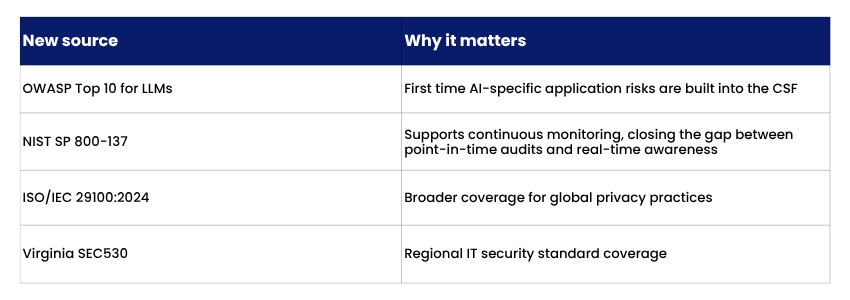
IT systems were continuously assessed and monitored by this version of the CSF, which is also the functionality that the majority of users seek from the CSF.

Performance Insights from the Report
According to the report, results get better over time when organizations adopt assurance as a process, not an annual event. Well-structured programs and internal controls for ongoing assessment and correction plans become even more effective as organizations gain experience.
Key Takeaways:
Fix findings, not just record them. Corrective action plans are part of the model.
Reuse evidence. Controls you validate once should support more than one framework. Our evidence automation page explains how.
Measure outcomes. Track whether controls actually operate, not only whether policies exist.
Track the applicable version. Maintain a record of the CSF version and assessment type for every validated assessment submitted through MyCSF. Readiness assessments are not QA'd (Handbook 4.1).
Assurance Quality Under the Spotlight
The quality of each assessment ultimately determines the level of confidence users place in HITRUST’s assurance process. Accordingly, HITRUST conducts a quality review of every assessment completed through the HITRUST Report Center.
If you use HITRUST’s framework, consider how well your controls protect the data that matters most to you. To make it easier to implement controls and support your security assessments, visit our Audit Management page.
What to Do Next: Steps After the 2026 Trust Report
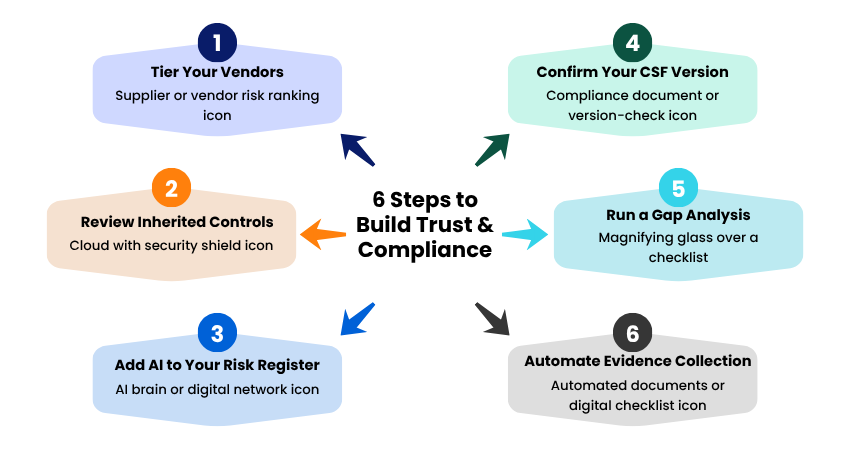
Turn the report into action with this brief plan:
- Tier Your Vendors: Rank vendors by data sensitivity or business impact, and require validated assurance, not just questionnaires.
- Review Your Inherited Controls: Compare your existing controls against a list of the controls offered by cloud and SaaS providers, and check that their reports are up to date.
- Add AI to your Risk Register: Track AI usage, define your data exposure, and align controls with recognized standards.
- Confirm Your CSF Version: HITRUST CSF v11.9 was released on September 24, 2026. If you’re planning or renewing an assessment, check with your assessor which version applies and by when you need to complete your assessment.
- Run a Gap Analysis: This compares your existing controls with the framework before a formal assessment. Follow our guide to conduct a compliance gap analysis.
- Automate Evidence Collection: Gather proof automatically. Ongoing collection works better than scrambling the night before an audit.
From Report to Action
A trust report is of limited value unless it informs your actions. Begin here:
- Rank vendors by the data they handle, prioritizing validated proof over questionnaires.
- Know your cloud and SaaS providers’ commitments, and ensure their reports are current.
- Add AI to your risk register before it turns into a blind spot.
- Run a gap analysis before the official assessment.
- Always keep your evidence up to date so you're never up all night before your audit.
Anyone can claim to have effective controls, but customers seek evidence. INTERCERT is an independent certification organization. We assess your controls against ISO/IEC 27001 and ISO 22301 and, if they meet the requirements, issue the relevant certificate. Because we are not involved in designing those controls, our certification carries independent credibility. INTERCERT is also an authorized HITRUST External Assessor, so we can support your HITRUST assessment as well.
Don't just claim you are secure. Prove it. Contact us to speak with an INTERCERT expert.


 +1 (281) 720-3261
 info@intercert.com
 2001 Timberloch Place - Suite 500, The Woodlands, Texas 77380, United States