


HIPAA Contingency Plan: Rules, Core Components, & Audit Expectations.
A HIPAA contingency plan sets out how an organization will respond to an emergency or other occurrence (such as fire, vandalism, system failure, natural disaster or a ransomware attack) that damages systems containing electronic protected health information (ePHI). When a hospital system goes down, the first question is how quickly critical data and systems can be restored. A documented, tested contingency plan answers that question.The requirement is concise, but auditors examine it closely. This guide explains the requirements of 45 CFR 164.308(a)(7), how to develop each component,what documentation auditors typically review, and where organizations most often encounter challenges. It is intended for HIPAA covered entities and business associates.
What Do the HIPAA Rules Say About Contingency Planning?
The Security Rule requires covered entities and business associates to implement appropriate policies and procedures for responding to emergencies that damage systems containing electronic protected health information (ePHI). Examples given in the Security Rule include fire, vandalism, system failure and natural disaster. The same principle applies when access to protected health information stored in electronic systems is lost, including as a result of a ransomware attack.
The standard is 45 CFR 164.308(a)(7), which comprises five implementation specifications (i.e., the specific requirements for meeting the standard). Three are required; the other two are addressable. An addressable specification must be assessed to decide whether it is reasonable and appropriate for the organization. If it is, it must be implemented. If it is not, the organization must document why and implement an equivalent alternative measure, where reasonable and appropriate. Addressable does not mean optional
Documentation matters just as much as the plans. Under 45 CFR 164.316(b)(2), required documentation, including the contingency plan, must be kept for six years from the date it was created or the date it was last in effect, whichever is later.
Changes to the HIPAA Security Rule have been proposed but are not yet final, so the required/addressable distinction still applies. As of October 2026, no final rule has been published. The January 2025 proposed rule would require regulated entities to be able to restore certain critical systems and data within 72 hours of a loss. The federal regulatory agenda now targets July 2027 for a final rule (moved from May 2026). Until then, follow the current Security Rule and treat the proposed changes as a signal of where requirements are heading.
Contingency Planning Key Elements at a Glance
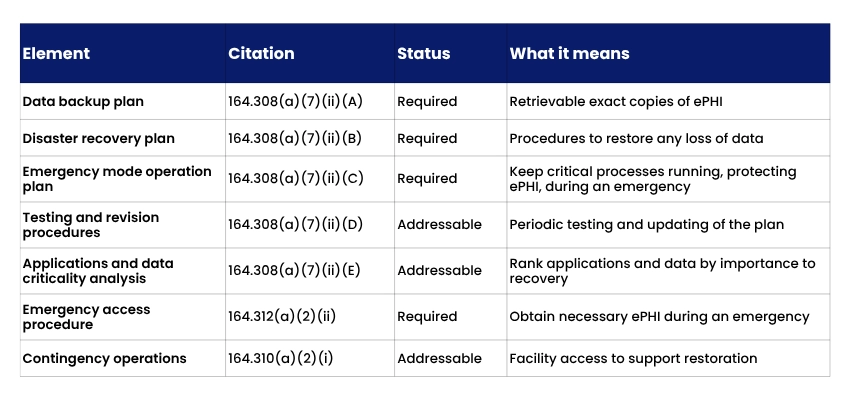
The last two rows (emergency access procedure and contingency operations) are related requirements from other parts of the Security Rule. They are not among the five contingency plan specifications
Five Core Pieces of a Modern HIPAA Contingency Plan
The five specifications (three required, two addressable) work as an integrated sequence. Criticality analysis establishes priorities, backup and recovery procedures address them, emergency-mode procedures bridge any gaps, and testing verifies that the entire process works effectively.
HIPAA Data Backup Plan (Required)
HIPAA requires procedures to create and maintain retrievable exact copies of ePHI. HIPAA does not prescribe backup technology, frequency or retention periods, so decide these based on risk and document the reasons. As good practice, keep at least one backup copy isolated from the production network, protect backups with the same encryption and access controls as live data, and regularly test that backups can be restored
HIPAA Disaster Recovery Plan (Required)
HIPAA requires procedures to restore any loss of data. As good practice, the disaster recovery plan should also name an owner, set recovery objectives (recovery point and recovery time objectives), list vendor and escalation contacts, and set the order in which systems are restored. It may also cover alternative ways to restore systems or data. A plan that relies on people remembering the restoration process is not adequate.
HIPAA Emergency Mode Operation Plan (Required)
The Emergency Mode Operation Plan explains how the organization keeps critical business processes running while still protecting the security of ePHI during an emergency. It describes procedures for clinical and business processes, such as billing. The description may also include measures to protect data and information, along with steps for reconciling them later.
HIPAA Testing and Revision Procedure (Addressable)
Testing and revision is an addressable specification, and HIPAA does not set a testing schedule. Even so, auditors and regulators expect contingency plans to be tested and updated regularly; testing at least once a year is widely accepted good practice. The January 2025 proposed rule would make testing at least every 12 months mandatory, but it is not final
HIPAA Application and Data Criticality (Addressable)
A criticality analysis ranks applications and data by how important they are to the organization's operations (for healthcare providers, usually patient care). This shows what must be restored first. Without it, systems may be restored in a random, uncoordinated order.
What Auditors Look for in a Contingency Plan During HIPAA and SOC 2 Audits
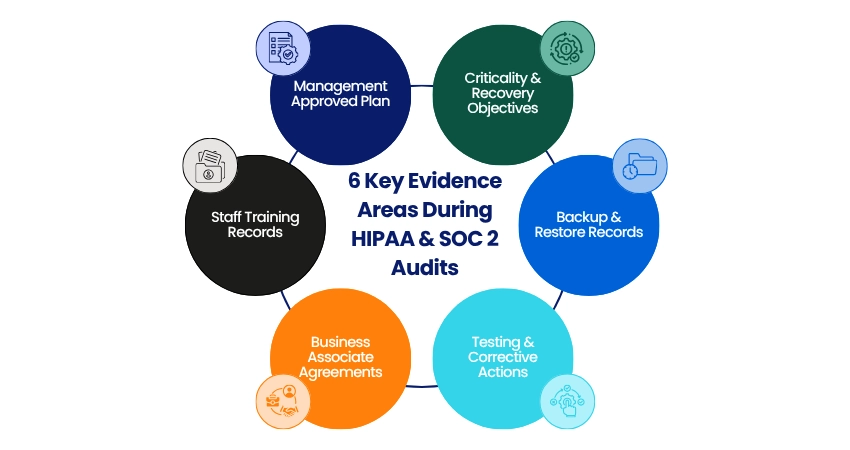
Auditors look for evidence that the contingency plan is documented, approved, implemented and tested. They typically ask to see:
- A documented plan approved by management
- The criticality analysis and recovery objectives
- Logs of backup activities and restores
- Test reports describing deficiencies and corrective actions taken
- Business associate agreements (BAAs)
- Staff training records
Auditors conducting SOC 2 (System and Organization Controls 2) examinations that cover the Availability criteria review similar documentation and evidence, including recovery plans and test results. ISO/IEC 27001 and ISO 22301 cover the same subject. These frameworks can provide independent assurance, but there is no official HIPAA certification, and HHS does not issue or recognize HIPAA certificates. For more information, see our HIPAA Compliance Guide.
The six steps below produce the evidence auditors ask for:
1. Run a Risk Analysis and a Criticality Analysis
Start with your HIPAA risk analysis. Then list the applications and data that hold ePHI, assess the impact if each one is lost, and rank them in order of recovery priority.
2. Put Preventive Controls and Backups in Place
A data backup plan is required. Preventive controls should follow from your risk analysis. They make an event less likely and reduce its impact.
3. Define Your Recovery Strategies
For each system, assess and document the recovery method to be used and the expected recovery time.
4. Draft the Master Contingency Plan
Consolidate all components, including role definitions, activation conditions, contact lists, and standard operating procedures, into a single plan.
5. Test the Plan and Capture Evidence
Simulate an emergency and document your findings. For a plan to be considered an adequate control, evidence of testing is required.
6. Set Up a Maintenance Cycle
Assign an owner and define the conditions that will trigger plan updates.
What a HIPAA Contingency Plan Should Include
The elements below combine HIPAA requirements with recognized good practice :
Key Components of a Contingency Plan
A contingency plan should include individuals’ contact information and responsibilities, communication procedures, activation criteria, and relevant excerpts from the organization’s incident response or action plan.
Data Backup Procedures
Document which ePHI and systems are backed up, how often, where the copies are stored, who can access them, and how they are encrypted.
Disaster Recovery Strategies
Determine appropriate data restoration strategies based on the functions and impact of the services that have been lost.
Emergency Mode Operation Plan
Define the conditions that require emergency mode. Specify the data to be captured and the procedures to be followed to return the organization to normal operations.
Emergency Access Procedures
The HIPAA Security Rule requires covered entities and business associates to have procedures for accessing necessary ePHI during an emergency. One common approach is to implement a break-glass account. A break-glass mechanism grants temporary elevated access in an emergency, with every use logged and reviewed afterward.
Applications and Data Criticality Analysis
List each application and data set, what it depends on (for example, network, other systems or vendors), its priority level and why, and its recovery objectives.
Alignment With Business Continuity Planning
The HIPAA plan should work hand in hand with the organization’s business continuity plan.
Records for Critical Systems
Keep records of critical systems, including those owned and operated by business associates.
Testing and Revision Procedures
Document how and when the plan will be tested, who takes part, how results are recorded, and how the plan will be updated afterward.
Types of Tests
Use a mix of tests suited to your organization's size and risk: plan reviews, tabletop exercises, step-by-step walk-throughs, technical restore tests, and failover exercises for the most critical systems
Testing Frequency and Triggers
Test the contingency plan at least once a year (good practice). Under 45 CFR 164.308(a)(8), also re-evaluate your safeguards when your environment or operations change, for example, after new systems, new vendors or a security incident
Ongoing Improvement
Treat every test, incident and near-miss as a chance to improve the plan. Update the plan and tell staff about the changes.
Best Practices for Putting the Plan Into Action
Every plan needs a named owner, clear triggers for activating it, and trained staff to carry it out. Make a named executive accountable and review the plan whenever systems, vendors or the organization change significantly.
Step-by-Step Checklist
1. Update or create a risk analysis.
2. Determine the criticality of applications and data.
3. Establish recovery objectives for each tier.
4. Implement and protect backups.
5. Document disaster recovery and emergency procedures.
6. Establish and utilize emergency access.
7. Make sure BAAs are in place, and that vendor contracts state backup and recovery commitments.
8. Test and amend plans to resolve deficiencies.
9. Conduct an annual review.
10. Retain plan documentation for six years from creation or the date it was last in effect, whichever is later
Keeping Security Tight During Emergencies
Keep security controls, logging and monitoring active during emergency operations and review every break-glass access afterward. After an attack, find out how the attackers got in and which systems or controls were affected, and fix these before returning to normal operations.
Common Audit Findings
These are the gaps auditors find most often:
•No formal plan, or a plan that has never been tested
•Backups that cannot be restored, or that share a network with the systems they protect.
•Speculative recovery order due to the lack of criticality analysis
•Failure to revise plans following system or service changes
•Missing emergency-mode procedures, or emergency workarounds that bypass security controls
•Business associates, such as cloud service providers, not covered in the plan
•Plan documents stored only on the systems they describe, so they are unavailable during an outage
Conclusion
A HIPAA contingency plan shows that your organization can keep ePHI available and secure when systems fail. Understand what the Security Rule requires, identify your most critical systems and data, back them up, and make sure they can be restored. Plan how critical functions will continue during a crisis, and test the plan regularly to confirm it works. For HIPAA's wider requirements, see our HIPAA Compliance.
For independent assurance of your continuity and security controls alongside HIPAA, consider frameworks such as ISO/IEC 27001 and ISO 22301. Talk to Intercert's experts about ISO/IEC 27001 and ISO 22301 certification. Get in touch to learn more.


 +1 (281) 720-3261
 info@intercert.com
 2001 Timberloch Place - Suite 500, The Woodlands, Texas 77380, United States