


GDPR vs. ISO 27001: Key Difference and How They Work Together
Businesses that process the personal information of individuals in the EEA must comply with the applicable requirements of the GDPR, including safeguarding the information and systems used to process it. The GDPR provides legal protections for data and privacy, while ISO 27001 establishes a set of prescribed measures for managing information security risks. In this context, a thorough understanding of the differences between the GDPR and ISO 27001 is essential.
To understand this more comprehensively, the GDPR is a regulation, whereas ISO/IEC 27001 is a standard guideline. Both, however, define approaches to achieving distinct goals but may be considered complementary.
Businesses are legally required to protect personal data. Implementing both GDPR and ISO/IEC 27001 can help them safeguard that data and reduce the risks posed by malicious parties.
ISO 27001 Explained: The Information Security Standard and What It Covers
ISO/IEC 27001 sets out the requirements for a business to establish, implement, and maintain a process for continually improving information security.
Through the implementation of an Information Security Management System (ISMS), businesses can identify potential risks that are posed to data and systems by malicious parties and implement controls to mitigate the risks.
Compliance with ISO 27001 can be confirmed through an audit, giving businesses confidence that their implemented systems and controls meet the standard.
What's changed in ISO/IEC 27001:2022?
In 2022, the Annex A controls in the ISO/IEC 27001 framework were updated and revised to reflect a reduced set of 93 controls in four themes: Organisational, People, Physical and Technological.
Key changes include:
Revised Security Controls: There was a reorganisation of controls from 114 controls within 14 domains in the previous standard to 93 controls within four themes in the updated standard (Organisational, People, Physical and Technological).
11 New Security Controls: These new controls can satisfy the pressing security requirements, such as threat intelligence, cloud security, data leakage prevention, secure coding and configuration management.
Updated Existing Controls: A few existing controls were consolidated, updated, or renamed to make them more logical.
Control Attributes: The revised approach to categorising and managing controls allowed for more flexibility in the level of control that could be employed according to its purpose and security functions and operational capabilities.
What Does This Mean for Organisations?
Organisations must update their ISMS to align with the new edition. ISO/IEC 27001:2013 certificates expired on 31 October 2025, and certificates issued under the 2013 edition are no longer valid.
A Structured Approach to Information Security and Risk Management.
Managing Information/financial Assets
An organization’s information assets include customer and employee records, financial and transaction data, databases, software, intellectual property, and other creations. Companies first identify which assets to protect, such as data, applications, and intellectual property.
ISO 27001 is used to measure the value of those assets, create risk assessments, and build appropriate safeguards.
Controlling Who Gets Access
Not every employee in an organisation needs access to all information assets. Access controls enable management to grant access according to the job functions of employees, contractors and third parties. The controls may include role-based access, certification, privileged access management, and periodic access reviews.
Securing Day-to-Day Operations
Security needs to be embedded into the way we work. ISO 27001 looks at security in areas such as safe operations, vulnerability management, managing supplier relationships, changes to the system and business continuity. This step assists companies in preventing unauthorized access, loss of data, and interruption of the business.
Handling Security Incidents
ISO 27001 stipulates that organisations should put in place procedures for the detection, reporting, assessment and treatment of information security incidents. This includes responsibility assignment, recording, and response to security events, to learn from these incidents and improve the ISMS.
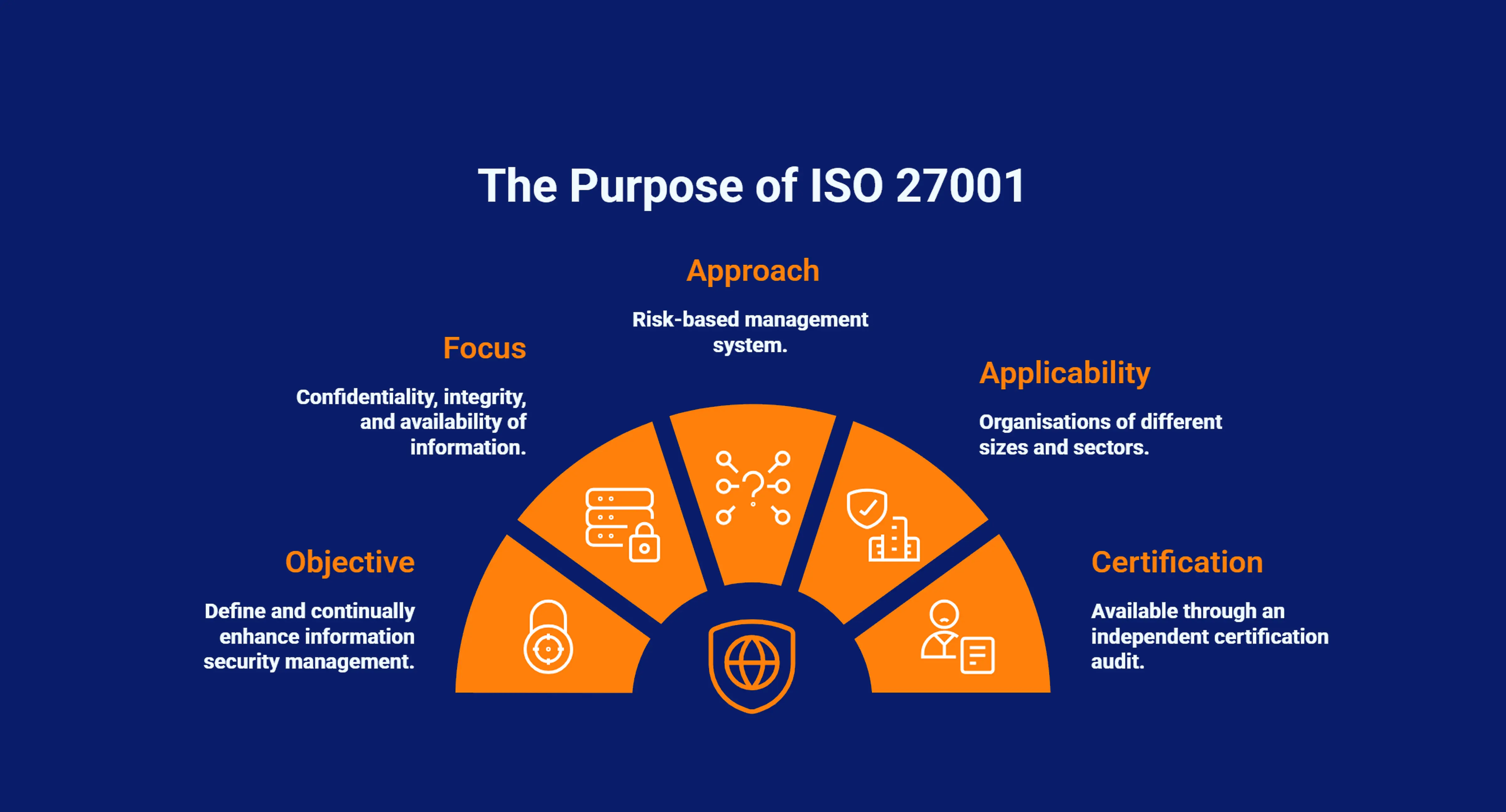
The Purpose of ISO 27001
Objective: Define and continually enhance information security management.
Focus: Confidentiality, integrity, and availability of information.
Approach: Risk-based management system.
Applicability: Organisations of different sizes and sectors.
Certification: Available through an independent certification audit.
Learn more about the standard in INTERCERT’s guide to ISO 27001.
GDPR Explained: The EU Privacy Regulation and Its Seven Principles
The General Data Protection Regulation, or GDPR, is the EU’s data protection regulation. It defines how organizations collect, process, store, and transfer personal data. It also outlines data subject rights.
The GDPR requires organizations to comply with its requirements regarding personal data, regardless of where the organization or the data subject is located, as long as the organization offers goods or services to, or monitors, data subjects in the EU.
The GDPR outlines seven key principles that organisations must follow when handling personal data. These principles form the foundation of responsible data protection and are explained below.
1. Lawfulness, Fairness and Transparency
Personal data must be processed fairly and transparently. Data subjects have the right to know the purpose for collecting their data.
2. Purpose Limitation
Personal data must be collected for specified purposes, and data cannot be used for other purposes that are incompatible with the original purposes.
3. Data Minimization
Personal data must be adequate, relevant, and limited to what is necessary to achieve the purpose for which it is processed.
4. Accuracy
Personal data must be accurate and kept up to date. The organization should take reasonable steps to ensure that uploaded data is corrected or deleted, as appropriate.
5. Storage Limitation
The collection of personal data must be kept for no longer than is necessary to achieve the purpose for which it is processed.
6. Integrity and Confidentiality
Personal data must be processed in a manner that ensures adequate security to protect it from unauthorized or unlawful processing and loss, destruction, or damage.
7. Accountability
In order to demonstrate responsible compliance with GDPR principles, organisations should adhere to the proper maintenance of records, implement policies, and be able to demonstrate how privacy obligations are fulfilled.
For more details, check out INTERCERT's guide to GDPR Compliance.
Security vs Privacy: Where Each Framework Draws Its Boundaries
Security and privacy are correlated, but still adhere to the positive distinctions. Security refers to maintaining the integrity and confidentiality of information. Whereas Privacy refers to having the ability to control the flow of information in order to properly safeguard an individual's rights.
You are able to ensure the confidentiality of the customer database by encrypting the database, but database encryption doesn't resolve the right to capture the data, nor the right to hold the data.
Personal data & privacy - The GDPR and ISO 27001 have different scopes. The GDPR covers principles governing the life cycle of personal data, while ISO 27001 addresses information security to reduce data leaks and cyber threats. In some cases, security controls may not be sufficient to meet privacy requirements.
The scope, purpose and approach of the GDPR and ISO 27001 differ on data protection issues. The GDPR sets out seven principles concerning the collection, processing and disposal of personal data. Principles three to seven set out security controls and other safeguards. They also explain how ISO 27001 controls can help manage information security risks and support GDPR obligations.
Organizations should carefully consider the distinctions between the two frameworks to develop a comprehensive understanding of data privacy and security.
GDPR vs ISO 27001: 4 Key Differences Compared
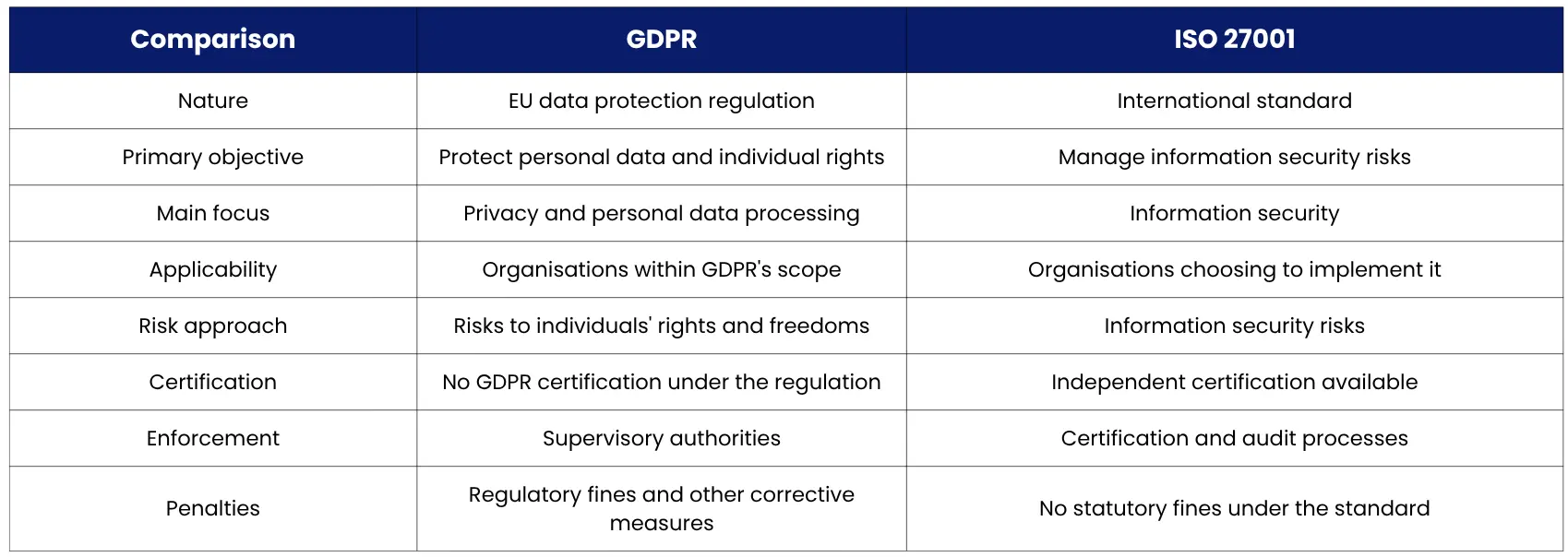
While both frameworks enhance data security, their goals, demands and compliance processes are not the same.
1. Security as a principle
The GDPR covers aspects such as purpose, processing, collection, valid grounds, rights and retention of personal data.
ISO 27001 can be used to protect personal data; however, it does not address every GDPR requirement.
2. Two Different Definitions of Risk
Under the GDPR, risks associated with processing personal data include negative impacts on data subjects, such as financial, psychological, physical, or other losses. Identity fraud is one example of a risk identified in the GDPR.
Under ISO 27001, risks arise from breaches of information confidentiality, integrity, or availability and affect the organization's processes and activities.
3. Who Must Comply: Legal Mandate vs Voluntary Standard
GDPR applies to organizations in the European Union that process personal data of individuals. It also applies to organizations outside the European Union that provide goods or services to individuals in the EU, and to those that monitor the behavior of individuals in the EU.
Entities covered by the GDPR include:
- EU-based businesses
- Non-EU businesses
- Public authorities
- Data controllers
- Data processors
ISO 27001 is a voluntary standard. Organizations in sectors such as SaaS, IT, finance, healthcare, and government or the public sector may pursue certification to meet client and contractual partner requirements or in response to requests from supervisory authorities.
4. Consequences without compliance
The GDPR outlines that intentional or negligent violations of some of its provisions may result in administrative fines between €10 million and €20 million or up to 4% of the infringing organization's worldwide annual revenue of the preceding financial year.
ISO 27001 does not provide for any sanctions, but failing to comply with it can negatively impact your business, increase the risk of operational cybersecurity threats, and lead to financial consequences.
Comparison between GDPR and ISO 27001
Requirements and Controls: Matching Each Framework’s Structure to Compliance Needs
GDPR vs ISO 27001 differ in structural organization. The GDPR sets out legal obligations and rights relating to personal data, the reporting of individual data breaches, and the responsibilities of data controllers and processors, among other matters.
An ISO 27001-based system is managed through ten main clauses and 16 optional controls outlined in Annex A.
Mapping GDPR and ISO 27001 assists in the identification of security controls to be implemented to meet GDPR requirements.
For example:
GDPR article 5(1)(f) and article 32 match the controls in ISO 27001 covering access management, cryptography and information security.
GDPR article 25 on data protection by design and by default supports secure development, risk assessment and access control.
GDPR records of processing activities are examples that can be used to evidence documented information management processes.
Incident management procedures for information security can be used to underpin Article 33 of GDPR concerning personal data breach notification.
Although ISO 27001 can help with GDPR compliance, it does not, by itself, satisfy the legal requirements.
Where GDPR and ISO 27001 Overlap
GDPR and ISO 27001 share the same broad goal of setting standards and guidelines for managing risks and protecting information. Both standards require and recommend managing information in a way that assesses risks and applies appropriate measures to protect it.
These standards overlap in the following areas:
- Managing access to information, especially personal information.
- Protecting information and setting standards for information security.
- Responding to security incidents and notifying the data protection authority and the data subjects in case of a personal data breach.
- Assessing and managing risks and threats to the security of personal data.
- Managing the security and data protection of third parties with whom the organization has contracted.
- Regular evaluation of the organization’s security controls and processes.
In achieving compliance with both standards, organizations may incorporate similar safeguards to manage security risks and information. This approach may also help address overlapping requirements and eliminate unnecessary duplication.
Does ISO 27001 Certification Mean You Are GDPR Compliant?
No. ISO 27001 certification does not ensure an organization meets the requirements of GDPR.
ISO 27001 outlines requirements for an Information Security Management System (ISMS). Certification means that an organization’s ISMS has been assessed and found to be in conformance with the requirements of the standard by an independent third party.
Other requirements of GDPR, for instance, Article 6 of the regulation, which sets out requirements for the lawfulness of processing personal data, are beyond the scope of information security.
While ISO 27001 provides evidence of an organisation’s security governance, meeting its requirements does not necessarily mean that the GDPR requirements are also satisfied. The organisation must therefore assess and address GDPR requirements separately.
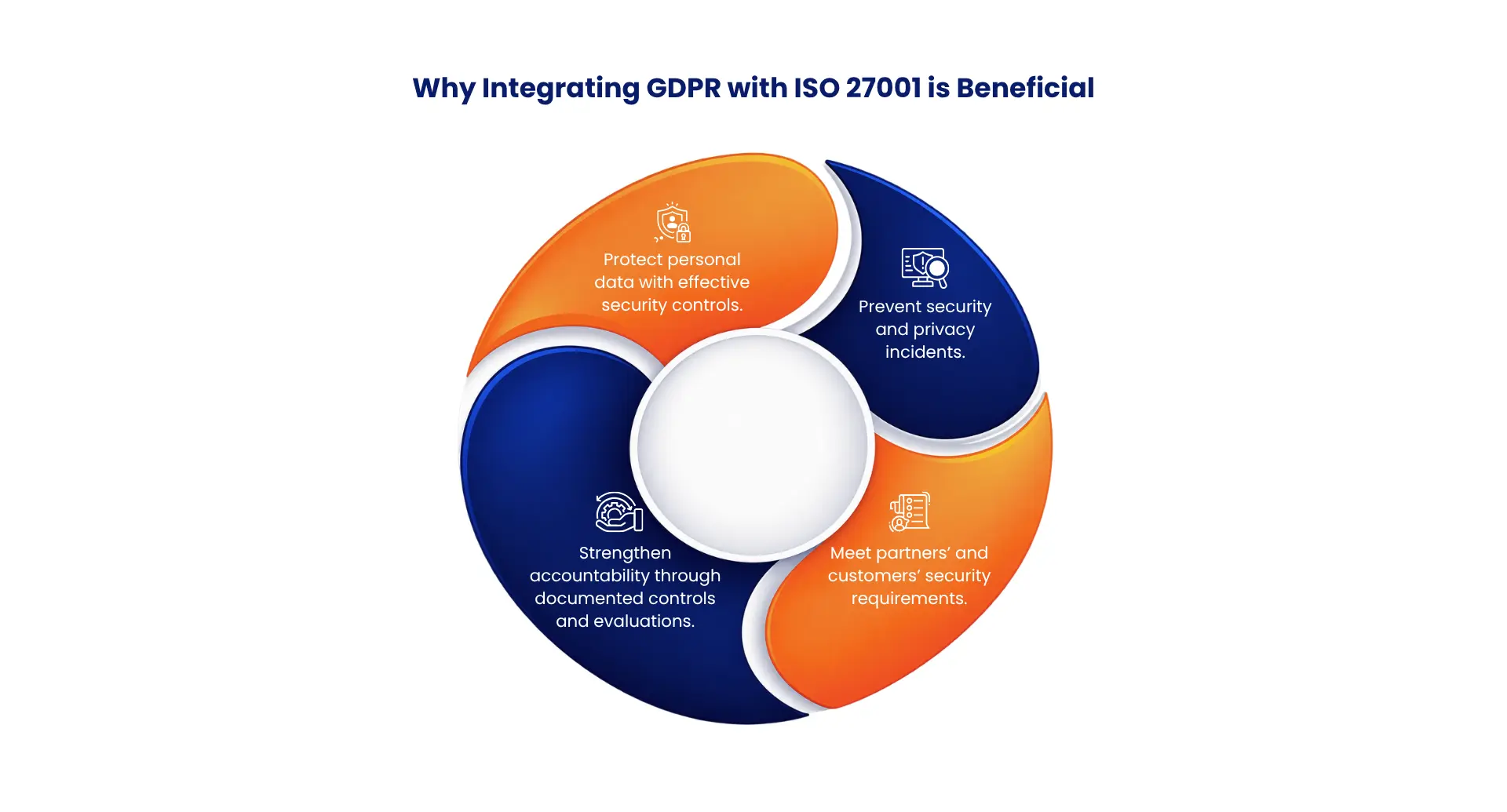
Why GDPR and ISO 27001 Compliance Work Best Together
A hybrid approach towards GDPR and ISO 27001 increases and improves an organization’s information security and privacy protection. The GDPR focuses on the requirements and rights of data subjects. On the other hand, ISO 27001 outlines requirements for information security and risk management.
Combining the two standards allows an organization to:
Better protect personal data through implementation of security controls.
Anticipate and prevent security and privacy incidents.
Meet security governance requirements of partners and customers.
Enhance accountability through documentation of evaluation and implementation of controls.
This is particularly valuable for large organizations seeking to protect the personal data of employees and customers.
Bridging the Gap Between Privacy and Security
In practice, an organization’s privacy obligations are integrated into its information security processes and procedures.
Amongst others, the integration may include:
Mapping personal data and where it is located.
Assessing and documenting the legal basis and purposes for processing personal data.
Retaining personal data in accordance with the processing purposes.
Conducting security and privacy impact assessments.
Using and accessing personal data only where and when required.
Employing access controls and encryption.
Developing an incident response plan and notifying supervisory authorities when a personal data breach occurs helps assess and ensure the adequacy of security and privacy controls.

Common Challenges and How INTERCERT Can Help
Organizations often face overlapping documentation, unclear ownership, and inconsistent risk assessments when implementing GDPR and ISO 27001 at the same time. They also find it challenging to maintain sufficient evidence to support both frameworks concurrently.
Other challenges include:
Misunderstanding of information security controls and legal privacy controls.
Inadequate or lack of inventory of personal data and/or information.
Absence of assessment of suppliers against the GDPR.
Lack of general awareness of responsibilities among staff and management.
Inadequate gaps in incident reporting and documentation.
To address these challenges with ease, INTERCERT offers a range of assessment and certification services that help organizations evaluate and demonstrate the compliance of their information security management systems.
If your organization is considering enhancing its information security and governance in accordance with the GDPR and/or pursuing ISO 27001 certification, INTERCERT can provide an integrated evaluation.
Are you seeking to strengthen your information security and compliance posture? Contact INTERCERT to discuss your ISO 27001 certification and assessment needs.


 +1 (281) 720-3261
 info@intercert.com
 2001 Timberloch Place - Suite 500, The Woodlands, Texas 77380, United States