


EU AI Act Timeline: Key Dates, Deadlines, and Who They Apply To
The EU AI Act (Regulation (EU) 2024/1689) has taken effect in phases since it entered into force on 1 August 2024. In 2026, Regulation (EU) 2026/1744, known as the Digital Omnibus on AI, was published in the Official Journal on 24 July 2026 and entered into force on 27 July 2026. Most notably, it delayed the high-risk obligations until 2 December 2027 for Annex III systems and 2 August 2028 for AI embedded in regulated products.
This may create uncertainty for organisations implementing the Act. The following section sets out each date, explains its significance, and recommends steps to ensure compliance by the applicable deadline. Before acting on any date, consult the Commission's AI Act page and the text published in the Official Journal, as the timeline has changed more than once.
Why a Moved Deadline Does Not Mean the Risk Is Gone
It’s important to understand that postponing the high-risk obligations of a ‘high-risk’ AI system does not also postpone the Act’s other provisions.
The Article 5 prohibitions on unacceptable AI practices took effect on 2nd February 2025. Obligations for providers of GPAI models throughout the EU took effect on 2nd August 2025. From 2 August 2026, the Commission can enforce the GPAI rules, including by imposing fines.
Extra time should not be seen as leniency for high-risk systems. Meanwhile, customers are asking suppliers about these systems and processes. In October 2026, EN 18286, the first harmonised standard under the Act, was published and cited in the Official Journal. Clearly, much work remains before the implementation deadlines set by the Commission.
Customers are increasingly asking suppliers how their AI is governed. Add a source if you retain this claim. Recently, more customers in the commercial and industrial sectors have required suppliers to provide evidence that their AI systems are governed by a third party. Consequently, other certification bodies have been asked to audit against the requirements of ISO/IEC 42001.
EU AI Act Dates Already in Application
The table below shows what applies as of mid-November 2026.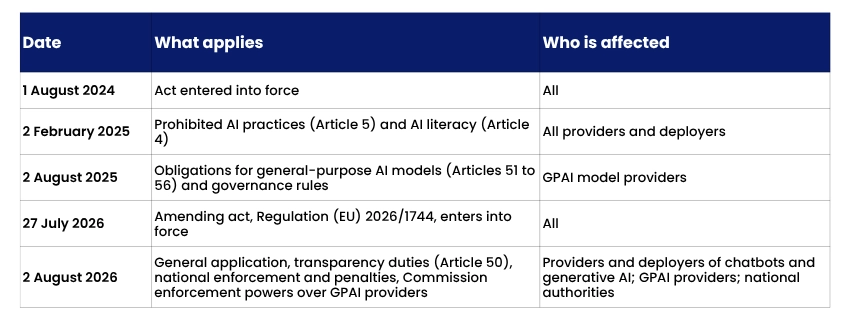
Two aspects of the amending act are worth noting. First, Article 4 was softened: providers and deployers must take measures to promote AI literacy among their staff, but they are not required to guarantee a specific level for each person. Second, under Article 50(2), generative AI systems placed on the market before 2 August 2026 have until 2 December 2026 to apply machine-readable marking to their output.
Scheduled EU AI Act Dates for Providers and Deployers
These are the EU AI Act key dates still ahead.
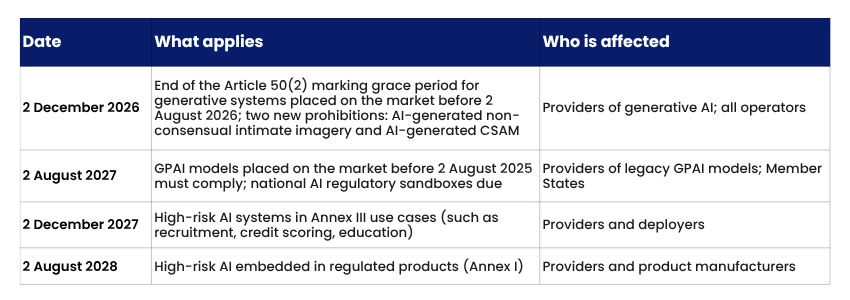
“The next deadline is 2 December 2026, followed by 2 August 2027, 2 December 2027 and 2 August 2028. Check which apply to your role and each system’s risk class, and confirm them against the Official Journal, since the timeline has changed before.”
What Is Your Role in the AI Supply Chain?
Deadlines mean little until you know your role. A single organisation can hold more than one.
AI Providers
A provider develops, or has developed, an AI system or GPAI model and places it on the market or puts it into service under its own name. Providers bear the most extensive obligations. Providers established outside the EU are also subject to these requirements if their systems are placed on the EU market or their output is used within the EU.
AI Deployers
A deployer uses an AI system under its own authority in a professional workplace setting. For example, banks and hospitals that use credit-scoring or diagnostic systems are deployers. Deployers decide how the AI system is used.
AI Importers
An importer is an EU-based company that places on the EU market an AI system bearing the name or trademark of a non-EU provider.
AI Distributors
A company that makes an AI system available on the EU market, despite neither developing nor importing the system.
Key EU AI Act Dates by Scenario
Most readers have one question: Which date applies to me? Find your scenario below.
Scenario 1: Providers of New GPAI Models
Starting 2 August 2025, if you release a new general-purpose AI model, the obligations under the EU AI Act will apply to it. From 2 August 2026, the Commission will be authorized to oversee providers of GPAI models and impose fines on them.
Scenario 2: Providers and Deployers of Chatbots and Generative AI
From 2 August 2026, the transparency obligations under Article 50 will apply to Providers and Deployers. Individuals must be told when they are interacting with AI, and deepfakes must be disclosed. Certain AI-generated messages that serve the public interest must also be identified. Providers of generative systems must label their systems’ outputs as AI-generated. Systems placed on the market before 2 August 2026 have until 2 December 2026 to meet this requirement.
Scenario 3: Providers and Deployers of High-Risk AI Systems
Stand-alone high-risk AI systems described in Annex III must comply with these requirements by 2 December 2027. High-risk AI systems integrated into products within the scope of Annex I must comply from 2 August 2028. Before these dates, the high-risk obligations do not yet apply. Article 111 transitional rules may affect systems already on the market.” Check Article 111’s wording.
Scenario 4: Providers of GPAI Models Already on the Market
Those systems have until 2 August 2027 to implement the Act’s requirements. Models placed on the market before 2 August 2025 have until 2 August 2027 to comply. Models placed on the market from 2 August 2025 must comply from the date of placement.
What Each Party Must Do Before Its Deadline
The following outlines the activities to be undertaken by each party before the implementation date of the EU AI Act.
Obligations for Providers
Providers of high-risk systems have additional responsibilities to implement and operate a risk management system.
- Use a system to manage risk (Article 9) and follow rules about how you handle data (Article 10).
- Prepare technical documentation (Article 11) and extract data automatically (Article 12)
- Provide deployers with instructions for use (Article 13) and design for human oversight (Article 14)
- Know more about accuracy, robustness and cybersecurity requirements (Article 15)
- Maintain a quality management system (Article 17)
- Complete conformity assessment, prepare the declaration of conformity and affix the CE marking
- Register the system in the EU database; follow up after launch of the system; report serious incidents
- If you are based outside the EU, nominate an EU authorised representative
GPAI models are to establish and maintain technical documentation and disseminate information to downstream providers of the model. They are also to implement a copyright policy and disclose a training-content summary. Systemic risk models have additional requirements such as incident reporting, evaluation and adversarial testing.
Obligations for Deployers
Users of high-risk systems must follow the provider's instructions to implement human oversight of the system's operation and retain logs for at least 6 months. Users must also report serious incidents to the provider. Public authorities and some users of high-risk AI systems that provide essential services must conduct an impact assessment to evaluate potential negative impacts on fundamental rights before using the system. Deployers must disclose deepfakes and certain AI-generated public-interest text, and must inform people when emotion recognition or biometric categorisation is used on them.
Obligations for Importers and Distributors
Before placing a system on the market, an importer must confirm that the supplier has completed a conformity assessment, prepared the relevant documents, and affixed the CE marking. Importers must retain evidence of conformity for at least 10 years. They must not place nonconforming systems on the market. Distributors must also verify that the system is conforming before placing it on the market. Both parties must assist authorities in taking corrective action to remedy any nonconformity.
Tracking Regulatory Changes vs. Managing Them
Tracking means recognizing when the effective date of a specific regulation changes. Managing means determining how that change affects the organization and assigning responsibility for implementing it.
Tracking regulations does not go much further than sending oneself a notification. Effectively managing and implementing the change requires more effort and resources to update the organization’s inventory of artificial intelligence and to revise the risk assessment of the AI system.
This is what an independent audit assesses. During an audit of a customer’s AI management system, a certification body such as INTERCERT evaluates whether the customer has implemented adequate processes to meet legal requirements related to AI.
Why the EU AI Act Makes This Gap Visible
2026 brings several changes to AI regulations. Recently, some high-risk deployment rules have changed, while the dates for providing transparency remain the same. A new prohibition has been added, and the wording of the duty to provide transparency about the AI in use has changed. Many organizations remain unsure which of their systems fall within the scope of these provisions.
One way to address this gap is to implement an AI management system, such as the system described in ISO/IEC 42001. Although the EU AI Act does not require organizations to implement such a system, it can help them adapt to evolving regulatory requirements. Read more about how ISO 42001 and the EU AI Act compare, and why organizations in Europe are adopting ISO 42001 to prepare for the EU AI Act.
A third-party audit boosts confidence in a management system. Because regulations change frequently, the system must adapt to remain effective. INTERCERT assesses systems against ISO/IEC 4200 standards. Its certifiers don’t develop the systems they audit, giving users and customers greater confidence in the results.
Conclusion
Deadlines under the EU AI Act depend on your role and each system’s risk classification, and the 2026 AI Omnibus has shifted several of them. So far, the prohibitions, AI literacy requirements, and obligations for general-purpose AI are in force. Two further bans are scheduled to take effect on 2 December 2026. Obligations for high-risk systems covered by Annex III will take effect on 2 December 2027.
The best time to get ready is before those dates arrive. Here are three simple steps to help you get started:
- Document all AI systems your organisation develops, purchases, or uses off the shelf. This is especially important for vendor products.
- For each system, identify your role: provider, deployer, importer, or distributor.
- Determine which responsibilities apply to each, and review them regularly as guidance and standards of practice evolve.
ISO/IEC 42001 certification does not ensure compliance. However, it provides a well-defined management system framework for AI governance, risk management, and documentation, and works well alongside EN 18286 to support quality management. As an independent body, INTERCERT assesses your AI management system against ISO/IEC 42001 and issues a certificate if it meets the requirements.
Ready to take the next step? Contact us to speak with an INTERCERT expert about ISO/IEC 42001 certification.


 +1 (281) 720-3261
 info@intercert.com
 2001 Timberloch Place - Suite 500, The Woodlands, Texas 77380, United States