


CMMC Level 2 Assessment: 5 Lessons from Successful CMMC Assessments
Organizations across the USA are preparing for CMMC certification as cybersecurity requirements become increasingly important for doing business with the U.S. Department of Defense (DoD). While many organizations invest heavily in technical security controls, actual assessments often reveal that success depends on much more than technology.
A successful CMMC Level 2 assessment requires consistent governance, well-documented processes, objective evidence, and a security program that operates effectively every day.
Organizations that treat compliance as an ongoing business function are generally better positioned to meet the CMMC compliance requirements and strengthen their overall cybersecurity posture.
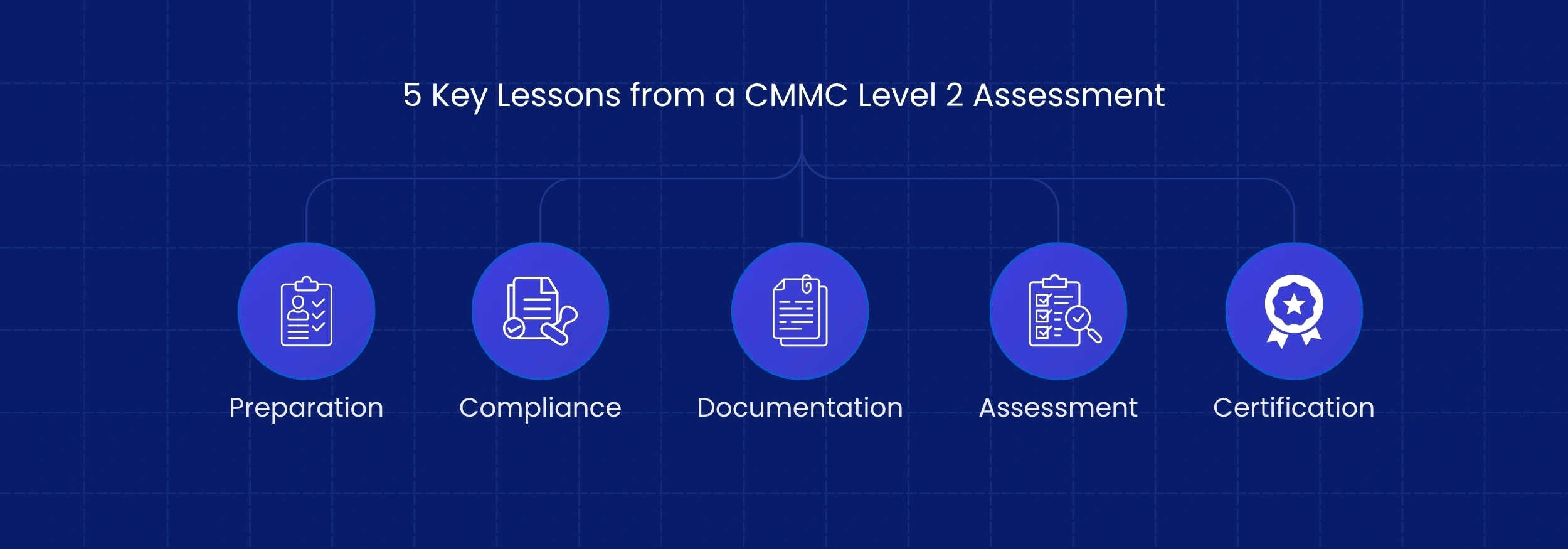
This article shares five practical insights to help organizations prepare for CMMC Level 2 certification.
Understanding CMMC Level 2
The Cybersecurity Maturity Model Certification (CMMC) 2.0 was developed by the U.S. Department of Defense to strengthen cybersecurity across the Defense Industrial Base (DIB) and improve the protection of Controlled Unclassified Information (CUI).
One of the most common questions organizations ask is about CMMC Level 1 vs Level 2.
Level 1 focuses on protecting Federal Contract Information (FCI) through a limited set of foundational cybersecurity practices. In contrast, Level 2 applies to organizations that process, store, or transmit Controlled Unclassified Information (CUI) and is aligned with the security requirements outlined in NIST SP 800-171 Rev. 2.
Unlike many Level 1 assessments, a CMMC Level 2 assessment for applicable organizations is performed by an authorized CMMC C3PAO (Certified Third-Party Assessment Organization). Assessors evaluate whether security controls are not only implemented but are also consistently operating and supported by objective evidence.
Understanding these expectations is an important first step in preparing for the overall CMMC assessment process.
Build confidence with customers and defense partners through CMMC Certification. Talk to Intercert about your certification needs.
Why Learning from Actual Assessments Matters?
Preparing for a CMMC assessment often begins with reviewing policies and implementing security controls. However, organizations across the USA frequently discover that real assessments focus on more than documentation alone.
Assessors evaluate how security practices operate within the organization, whether employees consistently follow established procedures, and whether objective evidence supports compliance claims.
While every assessment is different, recurring patterns emerge across successful organizations. These lessons provide valuable insight into what assessors commonly expect and where organizations often encounter challenges.
Instead of approaching CMMC certification as a one-time compliance exercise, organizations benefit from understanding how mature cybersecurity programs function in practice.
Lesson 1: Documentation Must Reflect Reality
One of the most consistent findings across CMMC Level 2 assessments is that documentation must accurately represent day-to-day operations.
Policies, procedures, the System Security Plan (SSP), network diagrams, and security documentation should align with how the organization actually manages cybersecurity. If documentation states that access reviews occur quarterly, assessors will expect evidence confirming that those reviews are consistently performed.
Common issues include outdated policies, incomplete asset inventories, inconsistent procedures, and documentation that no longer reflects the current environment.
Organizations that regularly review and maintain their documentation are generally better prepared for the CMMC assessment process and can demonstrate stronger operational maturity.
Lesson 2: Continuous Practices Matter More Than Last-Minute Preparation
Cybersecurity cannot be activated a few weeks before an assessment. Successful organizations establish ongoing processes for vulnerability management, patch management, security monitoring, access reviews, log management, incident response, and employee security awareness. These activities showcase that cybersecurity is embedded into normal business operations rather than being treated as a temporary compliance initiative.
Many organizations begin with a CMMC readiness assessment to better understand the maturity of their cybersecurity program before scheduling a formal assessment. While readiness activities do not guarantee certification, they can provide valuable insight into areas requiring additional attention.
Similarly, understanding the expected CMMC certification timeline enables organizations to allocate sufficient time for strengthening operational processes rather than rushing preparations immediately before an assessment.
Lesson 3: Protecting CUI Requires Organization-Wide Ownership
Protecting Controlled Unclassified Information (CUI) extends beyond the IT department. Every employee who creates, accesses, stores, transmits, or manages CUI plays a role in maintaining compliance. This includes engineering teams, project managers, human resources, executive leadership, procurement, and third-party service providers.
Organizations that perform well during a CMMC Level 2 assessment typically establish clear responsibilities for identifying CUI, applying appropriate security controls, managing third-party access, and maintaining employee awareness.
Executive involvement is equally important. Leadership establishes governance, allocates resources, and reinforces accountability throughout the organization. Without visible management commitment, cybersecurity programs often become inconsistent across departments.
Many organizations also benefit from maintaining a structured CMMC compliance checklist that outlines key responsibilities, required documentation, security activities, and evidence needed throughout the compliance lifecycle. Rather than serving as a simple task list, the checklist helps organizations maintain consistency and preparedness as cybersecurity requirements continue to evolve.
Lesson 4: Evidence Is Just as Important as Controls
One of the most important lessons from actual CMMC Level 2 assessments is that implementing security controls is only one part of the evaluation. Organizations must also provide objective evidence demonstrating that those controls are operating effectively. During the assessment, reviewers may examine system configuration reports, audit logs, multi-factor authentication settings, security awareness training records, vulnerability scan results, risk assessments, incident response records, and access review documentation. A security control that exists but cannot be supported with evidence may not meet the assessment objectives. Maintaining this evidence as part of routine operations, rather than collecting it just before the assessment, strengthens both operational maturity and overall readiness for CMMC certification.
Lesson 5: Governance Determines Long-Term Success
Organizations that consistently perform well during CMMC certification typically have clearly defined responsibilities, executive oversight, regular management reviews, and structured risk management processes. Cybersecurity becomes part of business decision-making rather than being treated as an isolated IT function.
Strong governance also encourages continual improvement. As systems evolve, new technologies are adopted, or contractual obligations change, organizations with mature governance processes are better positioned to adapt while continuing to meet CMMC compliance requirements.
Ultimately, long-term success depends on building a security culture where cybersecurity is viewed as an ongoing organizational responsibility rather than a one-time certification objective.
Common Challenges Organizations Face During a CMMC Level 2 Assessment
Although every organization is different, several challenges frequently emerge during the CMMC assessment process.
Some of the most common include:
- Incomplete or outdated System Security Plans (SSPs)
- Poorly maintained evidence and supporting documentation
- Unclear identification and handling of Controlled Unclassified Information (CUI)
- Inaccurate or incomplete asset inventories
- Limited executive involvement in cybersecurity governance
- Third-party vendor dependencies that introduce additional risks
- Legacy systems that do not fully align with current security requirements
- Policies and procedures that are not consistently followed across the organization
Recognizing these challenges early enables organizations to strengthen their cybersecurity program before a formal assessment begins.
Best Practices for CMMC Success
Organizations preparing for CMMC certification can improve their readiness by adopting a structured and proactive approach.
Some recommended best practices include:
- Clearly define the scope of systems that process, store, or transmit CUI.
- Keep the System Security Plan (SSP) current and aligned with operational practices.
- Maintain security evidence continuously rather than collecting it at the last minute.
- Conduct regular employee cybersecurity awareness training.
- Review third-party relationships and associated cybersecurity risks.
- Perform periodic internal reviews of security controls and governance processes.
- Update documentation whenever significant technology or business changes occur.
These practices contribute to stronger operational maturity and make it easier to demonstrate compliance during future assessments.
Preparing for Long-Term CMMC Compliance
Achieving CMMC certification should not be viewed as the end of the cybersecurity journey. Organizations that maintain continuous monitoring, regular risk reviews, governance oversight, and security awareness programs are generally better positioned to sustain compliance and respond to emerging risks.
Businesses should also recognize that factors such as organizational size, system complexity, the amount of CUI handled, remediation activities, and assessment scope can all influence the overall CMMC certification cost. Similarly, the CMMC certification timeline varies depending on the maturity of the organization's cybersecurity program and the extent of preparation completed before the formal assessment.
Investing in sustainable cybersecurity practices often delivers long-term operational benefits beyond regulatory compliance, including improved resilience, stronger customer confidence, and reduced business risk.
Advance your cybersecurity posture with CMMC certification from Intercert. Connect with our team to explore the next steps.
CMMC Success Begins Long Before the Assessment
Preparing for CMMC certification is about far more than implementing technical controls or completing documentation shortly before an assessment. The most successful organizations establish consistent governance, maintain accurate evidence, protect Controlled Unclassified Information through organization-wide accountability, and embed cybersecurity into their daily operations.
Whether your organization is beginning its CMMC readiness assessment, preparing for a CMMC Level 2 assessment, or refining its long-term cybersecurity strategy, the lessons learned from actual assessments highlight the importance of continual improvement, operational maturity, and disciplined governance.
As organizations across the USA continue strengthening their cybersecurity programs, aligning with internationally recognized management system standards can further reinforce governance, accountability, and organizational resilience. As an accredited certification body, INTERCERT provides independent certification services for globally recognized management system standards, enabling organizations to demonstrate their commitment to structured governance, effective risk management, and internationally accepted best practices.


 +1 (281) 720-3261
 info@intercert.com
 2001 Timberloch Place - Suite 500, The Woodlands, Texas 77380, United States