

5 Pillars of DORA: An Actionable Compliance Guide
Traditional cybersecurity frameworks focused on protecting individual systems. Today's financial environment requires something broader: ensuring that critical services remain available even when technology fails, cyberattacks succeed, or third-party providers experience disruptions.
Recognizing this shift, the European Union introduced the Digital Operational Resilience Act (DORA). Rather than asking organizations to eliminate every cyber risk, DORA requires financial entities to demonstrate that they can anticipate, withstand, respond to, recover from, and learn from ICT-related disruptions.
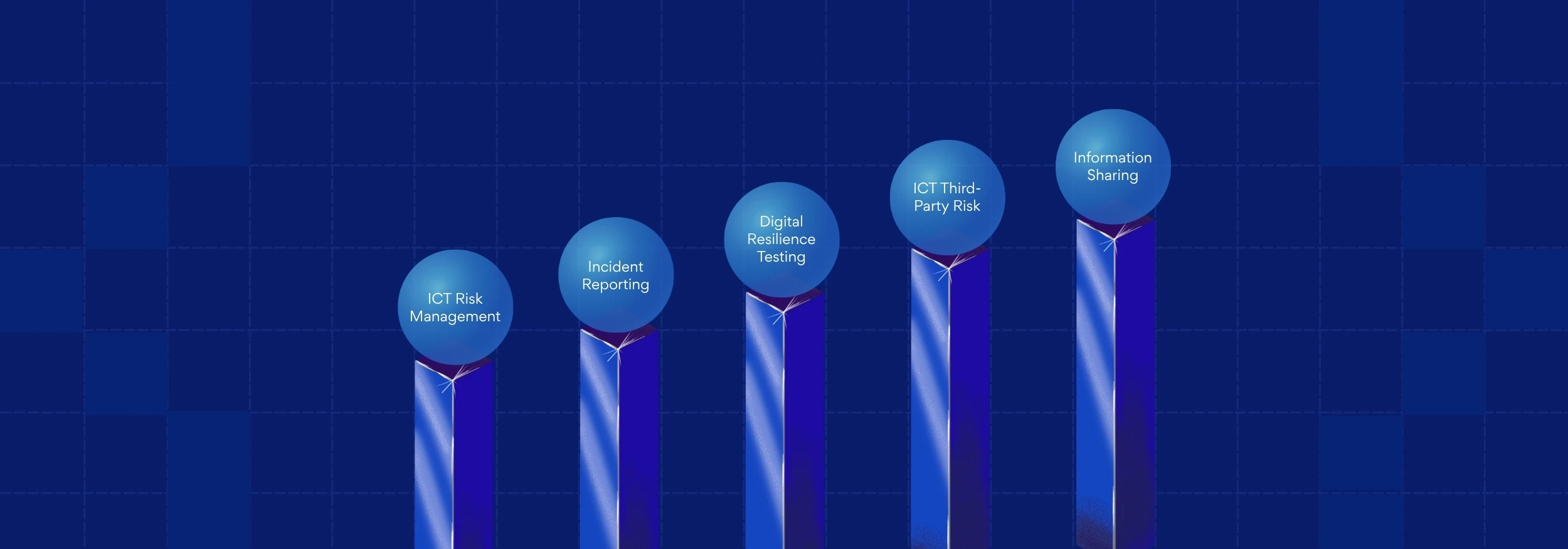
At the center of the regulation are the 5 Pillars of DORA, a structured framework that transforms operational resilience from a technical concern into an organization-wide governance responsibility.
In this guide, we'll explore what are the 5 pillars of DORA, explain how they work together, and discuss how financial institutions across Europe can build a stronger foundation for long-term digital resilience.
What Is DORA and Why Does It Matter?
The Digital Operational Resilience Act (Regulation (EU) 2022/2554) establishes a harmonized framework for managing Information and Communication Technology (ICT) risks across the European financial sector.
Before DORA, different EU member states often had varying operational resilience and cybersecurity requirements. This created inconsistencies that were difficult for multinational financial institutions and technology providers to manage.
DORA addresses this challenge by introducing a unified regulatory approach for organizations operating across Europe. Since becoming fully applicable on 17 January 2025, the regulation has required financial entities to demonstrate that they can continue delivering critical services even during ICT disruptions. Unlike traditional cybersecurity frameworks that primarily emphasize preventing attacks, DORA shifts the focus toward resilience.
The goal is no longer to eliminate every cyber threat but to ensure that critical business operations remain secure and uninterrupted when incidents happen. This change in mindset is reflected throughout the DORA framework pillars, each of which addresses a different aspect of operational resilience.
Understanding the DORA Five Pillars
Many organizations think of DORA as a cybersecurity regulation. In reality, it is much broader. The DORA five pillars establish a governance model that combines risk management, testing, incident response, third-party oversight, and industry collaboration into one continuous resilience program. The pillars complement one another to ensure that organizations can identify risks, prepare for disruptions, recover quickly, and continuously improve.
Pillar 1: ICT Risk Management
The first of the five pillars of DORA compliance focuses on establishing a structured ICT risk management framework. Every financial institution relies heavily on technology, making it essential to identify, assess, manage, and continuously monitor ICT risks before they disrupt critical operations. These risks may include ransomware attacks, cloud outages, software vulnerabilities, insider threats, or supply chain compromises.
To achieve this, organizations must implement governance policies, maintain asset inventories, conduct regular risk assessments, establish security controls, and align business continuity and disaster recovery planning with their overall risk strategy. DORA also places significant responsibility on senior management, requiring them to actively oversee ICT risk rather than treating it as solely an IT function. During assessments, auditors typically look for documented policies, risk registers, clearly assigned ownership, and evidence that the risk management framework is reviewed and improved on an ongoing basis.
Pillar 2: ICT Incident Management, Classification, and Reporting
Since no organization can prevent every cyber incident, the second pillar focuses on ensuring that ICT incidents are detected, classified, managed, and reported in a consistent manner. Financial institutions must establish clear procedures for identifying incidents, assessing their severity, escalating them internally, reporting major incidents to regulators, and performing root cause analyses to prevent recurrence.
For example, a cloud outage affecting online banking services should trigger predefined response and reporting processes instead of ad hoc decision-making. This standardized approach improves transparency and helps regulators identify broader risks across Europe's financial sector. Auditors generally assess incident response plans, reporting records, and post-incident reviews to verify that organizations not only respond effectively but also learn from each incident.
Pillar 3: Digital Operational Resilience Testing
The third pillar emphasizes that documented policies alone cannot demonstrate resilience. Organizations must regularly test whether their people, processes, and technologies can continue supporting critical business operations during disruptive events. Depending on the organization's size and risk profile, this may include vulnerability assessments, penetration testing, disaster recovery exercises, business continuity testing, crisis simulations, and Threat-Led Penetration Testing (TLPT).
The objective is to validate the organization's ability to recover from real-world scenarios rather than simply identifying technical vulnerabilities. Auditors therefore review testing schedules, results, corrective actions, and evidence that identified gaps are addressed, demonstrating that resilience testing is a continuous improvement process rather than a one-time compliance activity.
Pillar 4: ICT Third-Party Risk Management
Financial institutions increasingly rely on cloud providers, software vendors, payment processors, and other ICT service providers to deliver critical services. However, outsourcing technology does not transfer regulatory responsibility. The fourth pillar requires organizations to establish strong governance over third-party relationships through vendor due diligence, risk assessments, contract management, continuous monitoring, and well-defined exit strategies.
This requirement is particularly important across Europe, where many organizations depend on a small number of critical ICT providers. A disruption affecting one provider can have widespread consequences across the financial ecosystem. During audits, organizations are expected to demonstrate effective oversight through supplier inventories, contractual controls, ongoing monitoring, and documented assessments of third-party risks.
Pillar 5: Information Sharing
The final pillar recognizes that cyber threats evolve faster than any single organization can respond to on its own. DORA encourages financial institutions to participate in trusted information-sharing arrangements that enable organizations to exchange threat intelligence, emerging attack trends, and lessons learned from security incidents.
Although participation is voluntary, sharing relevant threat information helps organizations improve preparedness, strengthen defensive capabilities, and respond more quickly to emerging risks. Auditors may also evaluate how external threat intelligence is incorporated into the organization's broader ICT risk management processes, ensuring that industry insights contribute to continuous operational resilience.
How the Five Pillars Work Together
Understanding DORA pillars explained individually is only part of the picture. Their real strength lies in how they support one another. DORA framework pillars create a continuous improvement cycle that strengthens operational resilience over time.
- Risk management identifies potential threats.
- Incident management prepares organizations to respond effectively.
- Resilience testing validates whether controls actually work.
- Third-party oversight extends resilience beyond organizational boundaries.
- Information sharing enables continuous learning from the broader financial community.
Strengthen your digital operational resilience with INTERCERT .Take the next step toward EU DORA Certification.
Common Challenges When Implementing DORA
Although DORA provides a structured regulatory framework, implementation can be complex. Some of the most common challenges include:
Executive engagement
Operational resilience requires active involvement from senior leadership rather than relying solely on IT or cybersecurity teams.
Legacy technology
Older systems often lack the visibility, monitoring, and resilience capabilities expected under DORA.
Third-party complexity
Managing hundreds of ICT vendors while maintaining continuous oversight requires mature governance processes.
Documentation
Demonstrating compliance requires consistent documentation, evidence collection, and governance records.
Continuous monitoring
Organizations accustomed to annual compliance reviews must transition toward continuous operational resilience management.
Best Practices for Building Long-Term DORA Compliance
Long-term DORA compliance goes beyond regulatory requirements by integrating operational resilience into daily operations.
Integrate ICT Risk into Enterprise Governance
Avoid managing ICT risk as a standalone IT function. Instead, incorporate it into the organization's overall enterprise risk management framework, ensuring active oversight from senior management and the board.
Maintain Comprehensive ICT Asset and Vendor Inventories
Keep an up-to-date inventory of ICT assets, systems, applications, and third-party service providers. Better visibility enables organizations to identify dependencies, assess risks, and respond more effectively to disruptions.
Conduct Regular Resilience Testing
Go beyond technical security testing by evaluating business continuity, disaster recovery, crisis communication, and decision-making processes. Regular testing helps validate whether the organization can maintain critical services during real-world disruptions.
Strengthen Third-Party Risk Management
Continuously monitor ICT service providers instead of relying solely on periodic vendor assessments. Regular reviews of supplier performance, contractual obligations, and emerging risks help minimize third-party vulnerabilities.
Foster a Culture of Continuous Improvement
Operational resilience is an ongoing process. Regularly review incident reports, resilience testing results, audit findings, and industry threat intelligence to identify improvement opportunities and strengthen the organization's DORA compliance program over time.
Achieve EU DORA Certification with INTERCERT.Demonstrate your organization's digital operational resilience.
Putting the Five Pillars of DORA into Practice
While understanding what are the 5 pillars of DORA is essential, achieving digital operational resilience requires putting them into practice. The 5 Pillars of DORA provide much more than a compliance checklist. They establish a practical governance framework that helps financial institutions manage ICT risks, strengthen resilience, oversee third-party providers, improve incident response, and foster collaboration across the financial sector.
For organizations operating throughout Europe, these requirements represent a significant shift from traditional cybersecurity toward a broader resilience-first approach. By adopting the five pillars of DORA compliance as a strategic priority, organizations can strengthen resilience, maintain customer trust, and ensure business continuity.
As an independent certification body, INTERCERT works with organizations seeking to demonstrate conformity with internationally recognized standards and regulatory expectations. Organizations preparing for DORA or improving their governance and operational resilience can use certification to reinforce stakeholder confidence in their commitment to resilience and continuous improvement.


 +1 (281) 720-3261
 info@intercert.com
 2001 Timberloch Place - Suite 500, The Woodlands, Texas 77380, United States